Best Knee Sleeves for Lifting: Gymreapers Leads

Six knee sleeves ranked for squats, deadlifts and heavy pulls. Gymreapers takes the top spot on 7mm neoprene and IPF approval, with picks for every lifter.

By Christopher CarrUpdated 16 min read
On this page
- Best knee sleeves for lifting at a glance
- How I screened the field down to six
- 1. Gymreapers Knee Sleeves — Best overall
- 2. Iron Bull Strength 7mm Knee Sleeves — Most versatile
- 3. Phantom Athletic Club 7mm Knee Sleeves — Best upgrade
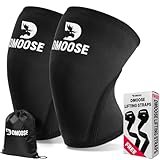
- 4. DMoose Fitness Knee Sleeves for Weightlifting — Best for pros
- 5. Jupiter Knee Sleeves — Best minimal setup
- 6. Bodyprox Knee Compression Sleeve — Best budget pick
- What 7mm neoprene actually does for a heavy squat
- Federation approval: does it matter for your lifting?
- Sizing knee sleeves without regretting it
- What to skip when you're shopping
- The verdict
- FAQ
The best knee sleeves for lifting are the Gymreapers Knee Sleeves, a 7mm neoprene pair built for heavy squats and IPF approved for competition. If you want two sleeves in the box for the price of one Gymreapers pair, the Iron Bull Strength 7mm Knee Sleeves are the better buy. Get the wrong sleeve for heavy work, though, and it slides mid-squat, pinches behind the knee, or offers no real rebound out of the hole. That's how a training session ends early.
Best knee sleeves for lifting at a glance
| Pick | Thickness | Federation approval | Price |
|---|---|---|---|
Best overall Gymreapers Knee Sleeves |
7mm neoprene | IPF approved (claim) | Check Price |
Most versatile Iron Bull Strength 7mm Knee Sleeves |
7mm neoprene | Not stated | Check Price |
Best upgrade Phantom Athletic Club 7mm Knee Sleeves |
7mm neoprene | IPL, USPA, IWF (claim) | Check Price |
Best for pros DMoose Fitness Knee Sleeves |
7mm neoprene | Not stated | Check Price |
Best minimal setup Jupiter Knee Sleeves |
7mm neoprene | Not stated | Check Price |
Best budget pick Bodyprox Knee Compression Sleeve |
Not stated | Not stated | Check Price |


How I screened the field down to six
The starting shortlist was longer than six. I cut every sleeve that failed one of three criteria, then ranked what was left.
First, the sleeve had to publish its neoprene thickness or clearly market itself for lifting. Five of the six survivors state 7mm neoprene on the listing. The sixth is the Bodyprox pair, which does not publish a thickness and is marketed for running and general workouts as much as for lifting. It stays in the set as the entry option a reader will inevitably compare against the thicker sleeves, but its role is honest: general knee compression, not competition support.
Second, the listing had to give me enough hard specs to make a real comparison. Size, count per pack, weight when supplied, dimensions when supplied. Sleeves with a blurry spec sheet were cut.
Third, the product had to be a sleeve, not a wrap. The DMoose product family includes wraps, and its category on Amazon reads as knee wraps, but the listing name and features describe a compression sleeve, so I kept it. Anything sold as a strap-and-wrap system was dropped.
That left the six here, all in a Large size (Bodyprox is the Medium option, sized differently by the brand).
1. Gymreapers Knee Sleeves — Best overall
The Gymreapers pair is the best knee sleeves for lifting because it combines 7mm neoprene with a stated IPF approval, and it's the only pick in the set that names a specific federation you can actually check against.
Best for: powerlifters running heavy squat cycles who want federation-legal kit Skip it if: you want a two-sleeve pack in the box
Gymreapers markets these as a 7mm neoprene sleeve built for heavy training, with reinforced stitching and compression aimed at stabilising the knee under load. That's manufacturer language, so treat it as a claim. What isn't a claim is what's on the spec sheet: dimensions of 2 x 10 x 8 in, model GR0047, and the listing's statement that the product is IPF approved. If you compete in a federation that follows IPF rules on knee sleeves, that matters more than any other line in this article.
The count is where you have to pay attention. The listing lists a count of 1, and the full title reads "1 Pair" plus a gym bag. Read the pair language on the listing itself before you check out, because four of the other five picks in this set ship as two sleeves in the box for a lower price position. Gymreapers is the most expensive pick here, and it's the slowest seller of the six on the sales data available. Neither of those is a strike against the product; both are context.
Pros:
- 7mm neoprene, the same thickness used by every other lifting pick
- Stated IPF approval, the only pick in the set to name a federation you can verify
- Reinforced stitching claimed for heavy training
- Includes a gym bag per the listing
- Model number published (GR0047) for warranty questions
Cons:
- The most expensive pick in this set
- The slowest seller here on the available sales data
- Count listed as 1, so confirm pair language before you buy
- No published weight or warranty on the listing
2. Iron Bull Strength 7mm Knee Sleeves — Most versatile
Iron Bull runs 7mm neoprene, ships as a pair at 0.84 lb for the two sleeves together, and sits a step below the Gymreapers on price while covering the same lifts.

Best for: lifters who squat, deadlift and press in the same session Skip it if: you prefer a lighter, thinner sleeve for tempo work
Iron Bull's pitch is straight: 7mm neoprene, "thicker than standard", built for the barbell rather than the treadmill. That framing tells you what the sleeve is designed to do and, just as usefully, what it isn't. The listed weight is 0.84 lb for the pair, and the colourway is black over charcoal. The count is 2, so you're getting both sleeves in the box at a price position that lands one step below the Gymreapers.
Iron Bull claims an anti-slip inner grip meant to stop the sleeve rolling between reps. That's a feature claim, not a measured fact, and how well any silicone lining stays put depends on your leg shape and how sweaty a session gets. What I can say from the data is that the sleeve is a genuine 7mm and the pair is priced in the premium range rather than the entry range. If federation approval doesn't apply to you and you want the same thickness as the Gymreapers in a two-sleeve pack, this is the direct trade.
Pros:
- 7mm neoprene at a lower price position than the winner
- Ships as a pair (count of 2)
- Published pair weight of 0.84 lb
- Anti-slip inner grip claimed on the listing
- Marketed for barbell lifts, not general fitness
Cons:
- No stated federation approval on the listing
- No published dimensions
- The generic model code ("ks") gives you nothing to work with
- Second-slowest seller of the six on the available data
3. Phantom Athletic Club 7mm Knee Sleeves — Best upgrade
Phantom sits in the middle of the price range, ships two sleeves in the box, and claims approval from three federations, which is more than any other pick names.

Best for: intermediate lifters ready to move up from a 5mm sleeve Skip it if: you compete in a federation not on the approved list
Phantom lists 7mm neoprene, a count of 2, and a black-over-slate colour. That's the whole hard spec sheet, which is thinner than I'd like for a sleeve in the mid price band. Where the listing does more work is in the feature copy: Phantom claims IPL, USPA and IWF compliance, which covers powerlifting under two federations plus Olympic weightlifting. That's a claim, not a certificate, so if you plan to compete in any of them, verify the current approved-equipment list before meet day.
Phantom is also the pick where the sizing note deserves attention. The listing tells buyers with larger calves or quads to size up, and warns that snugness is normal. Take that at face value: a 7mm sleeve should feel tight enough that you notice it going on. If it slides up easily, it's too big to do the compression job.
Pros:
- 7mm neoprene at a mid price position
- Ships as a pair (count of 2)
- Claims approval from three federations
- Clear sizing guidance on the listing
- Available in four sizes from S to XL
Cons:
- No published weight or dimensions
- Federation claims are on the listing only, not a certificate
- No model number, so warranty questions are harder
- The slowest mover in the middle of the pack
4. DMoose Fitness Knee Sleeves for Weightlifting — Best for pros
DMoose publishes a detailed size chart down to the inch, ships 7mm neoprene, and lists the fullest spec sheet in the set, including a weight of 0.88 lb.

Best for: advanced lifters logging heavy squats several times a week Skip it if: you want a small, packable sleeve for travel
DMoose is the one listing that treats sizing like a spec. The feature copy publishes measured ranges for every size: Small covers 11.8 to 13.0 in, Medium 13.0 to 14.2 in, Large 14.2 to 15.7 in, X-Large 15.7 to 17.0 in, and XX-Large 17.0 to 18.3 in. Measure your knee at the joint centre, sit inside those ranges, and you've done the hardest part of buying a knee sleeve.
The rest of the spec sheet holds up. Weight is 0.88 lb, colour is black, and model KS-N-04 gives you something to quote for support. DMoose sits in the middle of the set on price and near the middle on the sales data. The count on the listing reads as 5 rather than 2, which almost certainly reflects the accessory bundle language on the page. Read the count and pack details on the listing itself before you commit, the same way you would with any bundled sports item.
Pros:
- Detailed inch-by-inch size chart in the listing
- 7mm neoprene, matching the other lifting picks
- Published pair weight of 0.88 lb
- Model number published (KS-N-04)
- Anti-slip silicone lining claimed on the listing
Cons:
- The listing count reads as 5, so confirm pack contents before checking out
- No stated federation approval
- Categorised as knee wraps on Amazon, though it's a sleeve
- No published dimensions on the listing
5. Jupiter Knee Sleeves — Best minimal setup
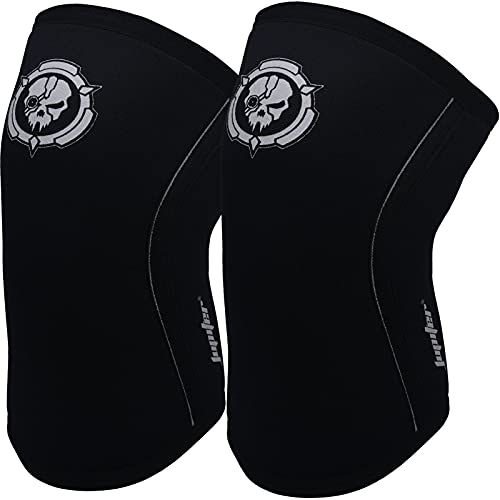
Jupiter is a 7mm neoprene pair sold in the entry price range, at a listed 0.62 lb for the pair, with the smallest published dimensions in the set.
Best for: lifters who want 7mm compression without the frills Skip it if: you need a printed federation approval
Jupiter is what happens when you strip a lifting sleeve back to its essentials. Same 7mm neoprene the winner uses, count of 2 in the box, a published pair weight of 0.62 lb, and dimensions of 0.55 x 10.2 x 7.09 in. It's the second-cheapest pick here. What it doesn't do is chase federation approvals, and it doesn't publish a model number.
For a lifter who trains hard but doesn't compete, that trade reads well. You get the thickness that matters for a heavy squat, in a pair, at the lower end of the price range. The weakness is that the listing gives you almost no hooks to hang a warranty question on if a seam fails, and Jupiter runs behind DMoose on the sales data. Wash it by hand, dry it flat, and you'll get more life out of any neoprene sleeve regardless of brand.
Pros:
- 7mm neoprene at the second-cheapest price position
- Ships as a pair (count of 2)
- Lightest published pair weight in the set at 0.62 lb
- Compact dimensions of 0.55 x 10.2 x 7.09 in
- Listed as washable in the feature copy
Cons:
- No stated federation approval
- No model number on the listing
- Slower mover than the DMoose or the Bodyprox
- Marketed for running as well as lifting, so read the fit notes
6. Bodyprox Knee Compression Sleeve — Best budget pick
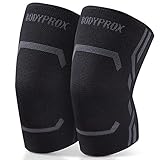
Bodyprox is the cheapest of the six, the fastest mover on the sales data by a wide margin, and the only pick that doesn't publish a neoprene thickness.
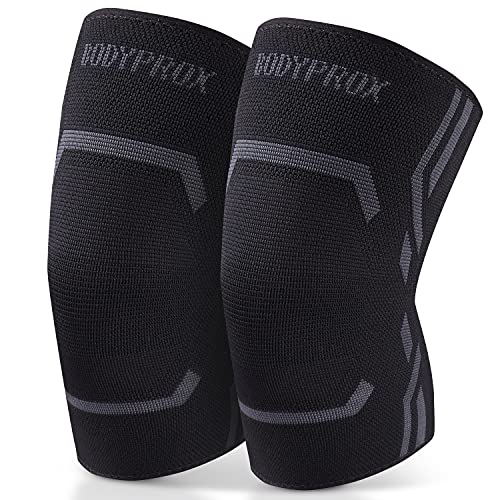
Best for: general gym-goers who lift moderate loads and run or cycle too Skip it if: you regularly squat above bodyweight and want thick neoprene
Bodyprox is the honest budget option. The listed size is Medium, the pair weighs 6 oz, the colour is black, and the count is 2. Model number BP-KneeSleeve is published for anyone chasing a warranty question. What you won't find on the listing is a neoprene thickness or a federation approval, and the feature copy talks about running and general workouts alongside gym use. Read that as design intent: this is a compression sleeve for broad athletic use, not a competition powerlifting sleeve.
That's why it's ranked last for this keyword, not because the product is bad. For lifting specifically, thin compression around the knee doesn't give you the rebound out of a heavy squat that 7mm neoprene does. If your programme is a mix of lifting, conditioning and cardio, and your top squat is well below limit, Bodyprox does the job at the lowest price point in the set. Above that, buy one of the 7mm picks and don't look back.
Pros:
- The cheapest pick in the set
- The one buyers choose most often here on the available sales data
- Ships as a pair (count of 2)
- Published pair weight of 6 oz
- Model number on the listing for support queries
Cons:
- No published neoprene thickness
- No federation approval named
- Marketed for running as much as lifting
- The Medium size on the listing may not match how the other picks size
What 7mm neoprene actually does for a heavy squat
Every serious lifting sleeve in this set uses 7mm neoprene, and five of the six put that figure on the listing. It's the deciding specification for this category, and it's worth understanding what the figure means before you compare on any other axis.
Thickness controls three things at once. It sets the amount of compression the sleeve applies around the joint, which is what warms the knee and increases blood flow in the local tissue. It sets the rebound the sleeve gives you at the bottom of a squat, which is why heavy squatters accept a sleeve that feels tight going on. And it sets the durability of the sleeve under load, because thicker neoprene has more material to work through before the seams take strain.
A 5mm sleeve, by contrast, sits closer to a compression brace than a lifting tool. It's comfortable, easy to walk in, easy to run in, and it'll cover a moderate squat session. It won't give you the same rebound out of the hole with a heavy bar on your back.
That's the split. If your squats are limit work or close to it, the 7mm picks here are doing something for you that a thinner sleeve won't. If they're not, save money.
Federation approval: does it matter for your lifting?
Three of the six picks name federation approvals on the listing. Only one, the Gymreapers, names the IPF directly. Phantom claims IPL, USPA and IWF compliance in its feature copy. The other three make no federation claim.
Here's the trick with federation approval. If you don't compete, none of it matters. Wear whatever fits and does the job. If you compete, or plan to, it matters more than any other feature on the listing, and it matters in a specific way:
- Federation-approved equipment lists change year to year, so a listing claim from any brand is a starting point, not a final answer.
- The federation you compete under sets the rules, not the one with the loudest logo.
- Approval usually covers named models at named thicknesses, so buying "an IPF-approved brand" isn't enough; you need the specific SKU on the current list.
- Meet directors have the final call on the platform, and they've been known to reject sleeves that look reused past their useful life.
For a competing powerlifter, Gymreapers is the safest starting point in this set because it names the federation most other bodies model on. Then check the current approved list before you enter.
Sizing knee sleeves without regretting it
Sizing is where most shoppers miss with knee sleeves. The listing gives you a size letter, S through XX-Large, and you pick the one that matches your gym shorts. That's the wrong approach for a compression sleeve, and it's why so many pairs end up unused in a gym bag.
Do this instead:
- Measure the circumference of your leg at the middle of the kneecap, standing.
- Then measure 4 in above the kneecap, at the quad.
- Take the larger of the two figures as your reference number.
DMoose is the one listing here that publishes a size chart in inches you can use directly, with Large covering 14.2 to 15.7 in and X-Large covering 15.7 to 17.0 in. Phantom's listing tells buyers between sizes to go up, and warns that snugness is normal. Take that as general advice for the whole category: a lifting sleeve should feel tight enough that you use both hands to pull it into place. If it slides up your leg easily, you'll get nothing out of it under the bar.
If you have larger quads, size up. If you have thin calves and big quads, expect any sleeve to feel looser at the calf. That's normal.
What to skip when you're shopping
A few things aren't worth paying extra for in this category, and a few are worth insisting on.
Worth paying for: a genuine 7mm neoprene thickness stated on the listing, a pair count of 2 in the box, and, if you compete, a specific federation approval you can verify. That's the whole list.
Not worth paying for: printed logos and colour bundles, extra "warmth" claims on a sleeve that's already 7mm neoprene, and anti-microbial coatings that fade after a few washes. These are marketing lines rather than performance features, and they don't change what the sleeve does under a heavy bar.
Watch out for these when you're comparing:
- Listings that describe the sleeve as suitable for running, cycling and lifting all at once. That usually means a thinner build.
- A count value of 1 that means one pair, and a count value of 1 that means a single sleeve. Read the full title carefully.
- Sleeves that publish no thickness at all, like the Bodyprox in this set. That's fine for general gym use, not for limit squats.
- Federation "approved" language with no federation named. If the listing won't name the body, treat the claim as marketing.
The verdict
The best knee sleeves for lifting are the Gymreapers Knee Sleeves, and the reason is narrow but decisive: they're the only pick in the set that names the IPF specifically. For any lifter who competes, or plans to, that single line on the listing is worth more than every other feature claim combined. The 7mm neoprene is standard for this tier, the reinforced stitching and gym bag are pleasant extras, and the price sits at the top of the range without leaving the range.
The runner-up is the Iron Bull Strength 7mm Knee Sleeves, and the reason is equally narrow: two sleeves in the box, the same 7mm neoprene, at a price position one step down. If you don't compete and don't need a federation logo, Iron Bull gives you the same core function for less outlay.
Two conditions flip the recommendation. If you're upgrading from a 5mm sleeve and want approval claims from more than one federation, Phantom is the pick. If you're not sure about sizing and want a listing that publishes inch ranges for every size, DMoose is the pick. Below limit-work loads, the budget Bodyprox pair covers general gym use without pretending to be a competition sleeve.
FAQ
Are 7mm knee sleeves better than 5mm for lifting?
7mm knee sleeves are better for heavy lifting because the extra neoprene delivers more compression around the joint and more rebound out of the bottom of a squat. Five of the six picks here list 7mm on the listing. A 5mm sleeve is easier to walk and run in, and it's a fine choice for moderate gym use, but it won't do the same job under a maximum squat.
Is it worth buying IPF-approved knee sleeves if I don't compete?
Buying IPF-approved knee sleeves if you don't compete isn't strictly necessary, but there's little downside. The Gymreapers pick in this set names the IPF directly. Federation approval usually signals that the sleeve meets a defined length and thickness spec, so you're getting a sleeve built to a known standard. If you never step on a platform, the approval is a nice-to-have, not a must.
How do I measure my knee for the right sleeve size?
To measure your knee for the right sleeve size, wrap a soft tape around the middle of your kneecap while standing, then repeat 4 in above the kneecap. Take the larger figure and match it against the brand's chart. DMoose publishes inch ranges for every size on the listing, so use that as a template. If you're between sizes, most listings, including Phantom, tell you to go up.
Gymreapers vs Iron Bull: which knee sleeves should I choose?
Gymreapers vs Iron Bull comes down to whether federation approval matters to you. Gymreapers names the IPF on the listing and ships one pair in a gym bag at the top of the price range. Iron Bull runs the same 7mm neoprene, ships two sleeves in the box at 0.84 lb, and sits one step below on price. Competing powerlifters pick Gymreapers. Everyone else can save with Iron Bull.
What common mistake do buyers make with knee sleeves for lifting?
The common mistake buyers make with knee sleeves is picking a size by their shorts letter instead of measuring. A lifting sleeve should feel tight enough that you use both hands to pull it on. If it slides up your leg without effort, it's too big to compress the joint properly. Measure the kneecap and the quad 4 in above, take the larger figure, and match it against the brand's chart.
The shortest route to the right pair here is this. If you compete under IPF rules, start with Gymreapers. If you don't compete and want two sleeves in the box, start with Iron Bull. If your budget is tight and your squats are moderate, start with Bodyprox. Everything else in this article is context around those three choices. Measure your knee before you order, expect the sleeve to feel tight for the first few sessions, and wash it by hand rather than tossing it in with your training kit. A 7mm neoprene sleeve, sized correctly and cared for, will outlast several training cycles, and that's what makes the winner earn its price.