Best Vegan Ashwagandha: NaturaLife Labs Leads

A capsule-versus-gummy breakdown of six plant-based ashwagandha supplements, ranked by dose, count and what each label actually publishes about its extract.

By Christopher CarrUpdated 16 min read
On this page
- Best vegan ashwagandha at a glance
- How I screened these six vegan ashwagandha picks
- Capsules or gummies: which form suits you?
- 1. NaturaLife Labs Organic Ashwagandha 2100 mg per Serving — Best overall
- 2. Goli Ashwagandha & Vitamin D Gummy — Best for beginners
- 3. Horbäach KSM-66 Ashwagandha — Best budget pick
- 4. Garden of Life Organic Ashwagandha with Probiotics & Ginger — Best for heavy use
- 5. YOLOBALANCE Ashwagandha Gummies — Best premium
- 6. Wholesome Story Vegan KSM 66 Ashwagandha Capsules — Best for families
- What does the milligram number on the label mean?
- How long does one bottle actually last?
- What the vegan ashwagandha labels don't tell you
- The verdict
- FAQ
The best vegan ashwagandha is NaturaLife Labs Organic Ashwagandha, which puts 2,100 mg per serving into a 100-capsule bottle and pairs full-spectrum root powder with a standardized extract at 2.5% withanolides. If swallowing capsules is the problem, Goli's Ashwagandha & Vitamin D Gummy uses the named KSM-66 extract across 60 gummies instead.
Get this pick wrong and you don't feel anything for six weeks, then quit. That's the real failure here. Underdosed bottles and vague labels are common, and the number on the front of the box is not always the number that matters.
Best vegan ashwagandha at a glance
| Pick | Form | Dose or count | Price |
|---|---|---|---|
Best overall NaturaLife Labs Organic Ashwagandha |
Capsules | 2,100 mg claim 100 count |
Check Price |
Best for beginners Goli Ashwagandha & Vitamin D Gummy |
Gummies | KSM-66 claim 60 count |
Check Price |
Best budget pick Horbäach KSM-66 Ashwagandha |
Coated caplets | KSM-66 plus L-theanine 60 count |
Check Price |
Best for heavy use Garden of Life Organic Ashwagandha |
Tablets | 600 mg claim 60 count |
Check Price |
Best premium YOLOBALANCE Ashwagandha Gummies |
Gummies | 2,000 mg claim 120 count |
Check Price |
Best for families Wholesome Story Vegan KSM 66 |
Capsules | 300 mg at 5% withanolides 60 count |
Check Price |


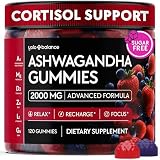

How I screened these six vegan ashwagandha picks
Every pick here states a vegan or plant-based formula in its own listing. That was the entry requirement, and it cut the field hard, because gelatin is the default capsule shell and the default gummy binder in this category. A gelatin softgel is not a vegan product no matter how organic the root inside it is.
From there I compared the published specifications side by side: count per bottle, stated milligrams per serving, whether the extract is named, and whether the listing publishes a withanolide percentage. Two of the six publish that percentage. Four name a specific branded extract or a milligram figure. One publishes neither, which is worth knowing before you buy.
What I could not screen for is anything the listings don't carry. None of these six publishes a certificate of analysis in the product data, and only two mention third-party testing at all. So the comparison below is a comparison of labels, dose forms and set position, not of assay results.
- Vegan or plant-based stated in the listing itself
- A published count per bottle, so cost per day is calculable
- Either a named extract, a milligram figure, or a withanolide percentage
- No gelatin, no undisclosed animal-derived binder
Three of the six are gummies or chewables in some form. That split turns out to be the decision most people are actually making.
Capsules or gummies: which form suits you?
Here's the trick with this category: form dictates dose ceiling, and dose ceiling dictates whether you notice anything. A capsule can hold packed root powder plus extract. A gummy has to hold flavour, structure and a pectin base, which leaves less room.
That shows up in the numbers. NaturaLife Labs claims 2,100 mg per serving in capsule form. YOLOBALANCE claims 2,000 mg in gummy form, but it splits that serving across a 120-count bottle, and the same gummy also carries L-theanine, GABA, magnesium, zinc and vitamin D3. Goli names KSM-66 but publishes no milligram figure in its listing at all.
Gummies win on adherence. A bottle you finish beats a bottle you abandon in a drawer, and if capsules make you gag, a 2,100 mg capsule is worth nothing to you. Capsules win on dose density and on ingredient simplicity: fewer things in the mix, less added sweetener, no flavouring.
My read: start with the form you'll actually take daily for eight weeks, then pick the highest published dose available in that form.
1. NaturaLife Labs Organic Ashwagandha 2100 mg per Serving — Best overall
The highest published dose in this set, in a 100-capsule bottle that also names its withanolide percentage.
Best for: someone who wants the highest published dose per serving Skip it if: you struggle to swallow capsules
This is the only pick in the set that combines a high stated dose, a published withanolide standardization and a bottle count above 100. NaturaLife Labs lists 2,100 mg per serving, made up of organic root powder, a standardized root extract at 2.5% withanolides, and organic black pepper. The 100-count bottle is the largest capsule count here by a clear margin, since every other capsule or tablet pick ships 60.
The withanolide figure is the part worth paying attention to. Withanolides are the active compounds in ashwagandha root, and a listing that publishes a percentage is telling you something a bare milligram number can't. Only one other pick here publishes one.
The brand also states no fillers, no magnesium stearate, no dioxides and no artificial additives, plus USDA Certified Organic, Non-GMO, gluten-free and vegan status. Those are the manufacturer's claims, not verified assays.
The trade-off against the gummies is obvious. This is a capsule you swallow, twice the size of a gummy commitment, with no flavour to soften it. And it sells fast in this set but not fastest: Goli moves quicker.
Pros:
- Highest stated dose in this set at 2,100 mg
- 100 capsules, the largest count among capsule picks
- Publishes a withanolide percentage of 2.5%
- Claims no fillers or magnesium stearate
- USDA Certified Organic and vegan per the listing
Cons:
- Capsules only, no chewable option
- Black pepper extract can bother sensitive stomachs
- No published warranty, unlike Goli
- Only two sellers list it
2. Goli Ashwagandha & Vitamin D Gummy — Best for beginners
The one buyers choose most often here, and the easiest entry point if capsules are a problem.

Best for: first-timers who want a named extract in gummy form Skip it if: you avoid added sugar
Goli sells faster than anything else in this set, and it's the second-cheapest pick here, which is an unusual pairing. The 60-gummy bottle carries KSM-66, a branded full-spectrum root extract that the listing describes as highly bioavailable, plus vitamin D. Mixed berry flavour. Vegan, non-GMO, gluten-free and gelatin-free, which matters because most gummies use gelatin.
For a first bottle, that combination is hard to argue with. You get a named extract rather than a generic "ashwagandha root", the format removes the swallowing problem entirely, and the bottle is small enough that a month of testing isn't a big commitment. Goli also lists a warranty, the only pick in this set that publishes one.
The gap is the dose. The listing names KSM-66 but does not publish a milligram figure per gummy, so you cannot compare it directly against the 2,100 mg on the NaturaLife bottle or the 600 mg on Garden of Life. That's a real limitation if dose is your deciding factor.
At 0.63 lb and 2.5 x 2.5 x 4.5 in, the bottle is compact enough for a bag. Against the capsules, you're trading dose transparency for palatability.
Pros:
- Sells faster than anything else in this set
- Names KSM-66 as its extract source
- Gelatin-free and vegan, unusual for gummies
- Second-cheapest pick here
- The only pick with a published warranty
Cons:
- No milligram dose published in the listing
- Gummy format means added sweetener
- 60 count is the smallest supply tier here
- Vitamin D addition may duplicate another supplement you take
3. Horbäach KSM-66 Ashwagandha — Best budget pick
The cheapest way into a named KSM-66 extract, with L-theanine bundled in.

Best for: someone testing a trial month cheaply Skip it if: you want the dose printed in the listing
This is the cheapest of the six and it still names its extract, which is the combination that earns it a spot. Horbäach lists KSM-66 ashwagandha extract plus L-theanine in each serving, across 60 coated caplets. Coated caplets are usually easier to swallow than an uncoated tablet, worth noting if that's your sticking point.
L-theanine is an amino acid found in tea leaves, and it appears in two picks here: this one and YOLOBALANCE. The difference is that YOLOBALANCE is the most expensive pick in the set and this is the cheapest, so if L-theanine alongside ashwagandha is what you want, the price gap between them is the whole story.
Horbäach states the formula is free of gluten, wheat, yeast, milk, lactose, soy, artificial flavour and preservatives, and that it's non-GMO and laboratory tested. Again, that's the label talking.
The weakness is disclosure. No milligram figure, no withanolide percentage, and no published weight in the listing. You're buying a named extract without a stated amount of it, and this is also the slowest-moving of the three capsule and tablet picks here except one.
Pros:
- Cheapest pick in this set
- Names KSM-66 extract specifically
- Adds L-theanine at a fraction of YOLOBALANCE's price position
- Coated caplets, easier to swallow than bare tablets
- Free of gluten, soy, dairy and artificial flavour per the label
Cons:
- No milligram dose or withanolide percentage published
- 60 caplets is a short supply at higher serving sizes
- No stated organic certification, unlike three other picks
- Sells slowly compared to the top two here
4. Garden of Life Organic Ashwagandha with Probiotics & Ginger — Best for heavy use
A 60-day supply in a single 60-count bottle, with probiotics and ginger built into the tablet.

Best for: daily users who want digestive support built in Skip it if: 600 mg per serving is too low for you
Garden of Life is the only pick here that states a 60-day supply from a 60-count bottle, meaning one tablet a day. For long, uninterrupted daily use that's the simplest routine in the set: no counting, no splitting a serving across two capsules.
The stated dose is 600 mg of organic ashwagandha root. That's the lowest published milligram figure among the picks that publish one, so this is not the pick if dose density drives your choice. What you get instead is the widest certification list here: USDA Organic, Non-GMO Project Verified, NSF Certified Gluten Free, vegan and kosher, according to the listing. Four separate third-party marks named on one label is rare in this set.
The formula also includes a 4 mg blend of probiotics and organic fermented ginger root, which Garden of Life says aids digestion and nutrient absorption. Ashwagandha root can sit heavily on an empty stomach, so the ginger is a sensible inclusion.
At 8 oz and 4.44 x 2.47 x 2.47 in, this is the heaviest bottle in the set. It's also filed under a different category branch than the other five, which is worth noting when you're browsing.
Pros:
- 60-day supply in one bottle, one tablet daily
- Names four separate certifications including NSF and kosher
- Includes probiotics and fermented ginger for digestion
- Publishes a clear 600 mg root figure
- Released in 2018, an established formula
Cons:
- Lowest published dose among picks that state one
- Heaviest bottle here at 8 oz
- No withanolide percentage published
- Probiotic potency at 4 mg is modest
5. YOLOBALANCE Ashwagandha Gummies — Best premium
The largest bottle in the set at 120 gummies, stacked with five supporting ingredients.
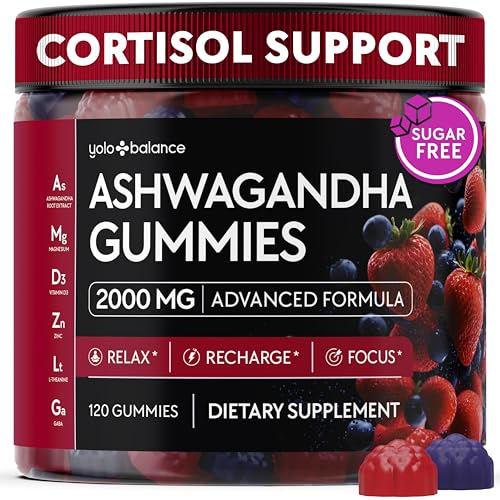
Best for: someone who wants a stack, not a single herb Skip it if: you want ashwagandha and nothing else
YOLOBALANCE ships 120 gummies, double every other bottle here except NaturaLife's 100 capsules. It claims 2,000 mg of ashwagandha per serving and adds L-theanine, GABA, magnesium, zinc and vitamin D3. It's also the only sugar-free option among the two gummy picks, which is the detail most likely to swing a decision if you're watching added sugar.
The brand frames the stack around relaxation and daytime energy: L-theanine and GABA for unwinding, D3 and zinc for daily wellness, magnesium across both. Whether you want that many actives in one gummy is the real question. If you already take magnesium at night or a separate D3, you're paying for overlap.
Berry flavour, 0.94 lb bottle, sugar-free, non-GMO and stated as 100% vegan. No withanolide percentage and no named branded extract, so the 2,000 mg figure stands on its own.
This is the most expensive pick here, and it's also the slowest seller among the three gummy and gummy-adjacent options. Against Goli you get a bigger bottle, a published dose and no sugar. Against NaturaLife you get flavour and 20 extra pieces, but a mixed formula rather than a clean single-herb one.
Pros:
- 120 gummies, the largest count in this set
- Sugar-free, unlike the other gummy pick
- Publishes a 2,000 mg per serving figure
- Adds L-theanine, GABA, magnesium, zinc and D3
- Berry flavour with a stated 100% vegan formula
Cons:
- Most expensive pick here
- No named extract or withanolide percentage
- Five added actives risk duplicating other supplements
- Slowest-selling gummy option in this set
6. Wholesome Story Vegan KSM 66 Ashwagandha Capsules — Best for families
The highest published withanolide percentage here, with Clean Label Project certification on the bottle.
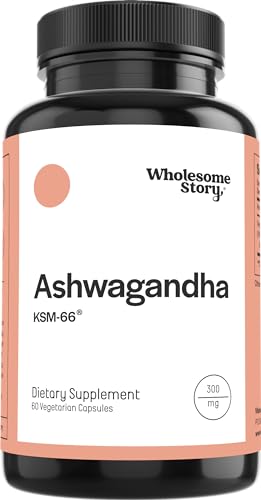
Best for: households that want third-party certification on the label Skip it if: you need more than a 30-day supply per bottle
Two picks here publish a withanolide percentage, and this is the higher of the two at 5%. Wholesome Story pairs that with a 300 mg ashwagandha root extract dose and names KSM-66 as the source, so all three of the numbers that matter for potency are on the label. That's the most complete disclosure in this set.
It's also Clean Label Project certified, third-party tested, dye-free and vegan-friendly, per the listing. For a household bottle, where more than one person might take from it, published testing carries more weight than a marketing claim. The brand describes itself as family-owned.
The catch is the maths. A 60-capsule bottle described as a 30-day supply means two capsules daily, and 300 mg per serving is the smallest stated dose in the whole comparison. If you want potency by milligram, this isn't it. If you want potency by withanolide concentration, it leads.
This is also the slowest-selling pick in the set by a wide margin, and the second most expensive. You're paying premium positioning for label transparency rather than for volume: 60 capsules and 4.5 x 2.5 x 2.5 in of bottle.
Pros:
- Highest published withanolide figure here at 5%
- Names KSM-66 and a 300 mg extract dose
- Clean Label Project certified and third-party tested
- Dye-free and vegan-friendly per the listing
- Publishes all three potency figures, unlike four other picks
Cons:
- Smallest stated dose in the set at 300 mg
- 60 capsules covers only 30 days at two daily
- Slowest-selling pick of the six
- Second-highest price position for the least volume
What does the milligram number on the label mean?
The number on the front of the bottle is the least useful figure in this category, and it's the one every shopper compares first. Here's why it misleads.
Ashwagandha listings quote milligrams of material per serving. That material can be raw root powder, a concentrated extract, or a blend of both. A 2,100 mg serving of mostly root powder and a 300 mg serving of concentrated extract are not on the same scale at all, because the extract has been reduced to concentrate the actives.
Withanolides are those actives. A withanolide percentage tells you how concentrated the extract is:
- Find the milligram figure for the extract portion, not the whole serving.
- Find the withanolide percentage.
- Multiply. That's your rough active load.
In this set, NaturaLife Labs publishes 2.5% withanolides and Wholesome Story publishes 5%. Four picks publish no percentage, so you cannot run step three on them at all.
The other shortcut is a named branded extract. KSM-66 appears on three picks here: Goli, Horbäach and Wholesome Story. A named extract at least tells you the raw material is standardized to a fixed specification, even when the listing skips the percentage.
How long does one bottle actually last?
Bottle counts in this set run from 60 to 120, but count alone tells you nothing until you know the serving size.
- Garden of Life: 60 tablets, stated as a 60-day supply. One a day.
- Wholesome Story: 60 capsules, stated as a 30-day supply. Two a day.
- NaturaLife Labs: 100 capsules, the largest capsule count here.
- YOLOBALANCE: 120 gummies, the largest bottle in the set.
- Goli and Horbäach: 60 each.
So the same 60 on two labels means two very different reorder cycles. Garden of Life is the only pick that stretches a 60-count bottle across two months, and that's a genuine convenience advantage for anyone who forgets to reorder.
Most shoppers miss this when comparing prices between bottles. A cheaper 60-count taken twice daily costs more per month than a mid-priced 100-count taken once. Work out the daily serving before you compare anything else, because ashwagandha is a supplement you're expected to take continuously for weeks before judging it.
If you're not sure you'll stick with it, the shorter bottles are the honest choice. Buy 60 and find out.
What the vegan ashwagandha labels don't tell you
The keyword here is "vegan ashwagandha", and I want to be straight about what that phrase does and doesn't guarantee across these listings. Every pick states vegan, plant-based or gelatin-free somewhere in its own copy. That's the brand's own statement, not an independent verification, and it's the same status as any other label claim in this set.
What the listings genuinely don't publish:
- No certificate of analysis appears in any product data here
- Only two picks mention third-party testing at all
- Four of six publish no withanolide percentage
- Two publish no milligram figure whatsoever
Ashwagandha is also a herb with real cautions attached, and none of these listings resolves them for you. If you're pregnant, on thyroid medication, on sedatives, or managing an autoimmune condition, the vegan status of the capsule shell is not the question you need answered. Ask a pharmacist or your doctor first.
The practical move: buy the pick that publishes the most, not the pick that promises the most. Wholesome Story and NaturaLife Labs publish more numbers than the other four.
The verdict
NaturaLife Labs Organic Ashwagandha is the best vegan ashwagandha here because it publishes more of what matters than almost anything else in the set and backs it with the largest capsule count: 2,100 mg per serving, 2.5% withanolides on a standardized root extract, and 100 capsules per bottle. USDA Organic and vegan per the label, with no fillers or magnesium stearate claimed. If you want one bottle to run a proper eight-week trial on, that's it.
Two conditions flip the pick. First, if you can't swallow capsules, none of that dose matters. Goli's gummy is then the right default: it names KSM-66, it's gelatin-free, and it's the one buyers here choose most often. Second, if withanolide concentration is your yardstick rather than raw milligrams, Wholesome Story publishes 5%, double NaturaLife's figure, plus Clean Label Project certification. You accept a 300 mg dose and a 30-day bottle to get it.
Wholesome Story's exact advantage over the winner is disclosure depth: named extract, milligram figure and withanolide percentage all on one label, with third-party testing stated. NaturaLife wins on volume and dose. That's the trade.
FAQ
Is vegan ashwagandha worth paying more for?
Vegan ashwagandha is worth paying more for only when the premium buys you something measurable. In this set, the two priciest picks buy you either a 120-gummy bottle with five added actives or a published 5% withanolide figure with third-party certification. The cheapest pick, Horbäach, still names KSM-66. Pay up for disclosure or volume, not for the vegan claim alone.
Which vegan ashwagandha gives the most for the money?
The best vegan ashwagandha for the money is NaturaLife Labs, sitting third of six on price while shipping 100 capsules at a stated 2,100 mg per serving. Per capsule, no other pick combines that count with a published withanolide percentage. Horbäach is cheaper outright but publishes no dose figure, so you can't verify what you're getting per caplet.
Do capsules or gummies absorb ashwagandha better?
Whether capsules or gummies absorb better is not something these listings answer, and neither format has an inherent edge you can read off the label. What differs is dose. Capsules here reach 2,100 mg per serving; the gummies either publish 2,000 mg alongside five other actives or skip the figure entirely. Pick the form you'll take consistently for eight weeks.
NaturaLife Labs or Wholesome Story: which should I buy?
Choosing NaturaLife Labs or Wholesome Story comes down to which potency number you trust. NaturaLife gives 2,100 mg per serving at 2.5% withanolides across 100 capsules. Wholesome Story gives 300 mg at 5% withanolides across 60 capsules, plus Clean Label Project certification. Buy NaturaLife for volume and a longer bottle. Buy Wholesome Story for concentration and published testing.
What mistake do first-time ashwagandha buyers make?
The most common mistake is comparing front-of-bottle milligrams across products that measure different things. Raw root powder and concentrated extract are not interchangeable at the same weight. The second mistake is quitting after ten days. Ashwagandha is taken continuously, so buy a bottle you'll finish and check the daily serving count before you compare price at all.
Start with the routine, not the bottle. Decide whether you'll take one capsule with breakfast or chew a gummy after dinner, then buy the highest published dose available in that form. For most people that means NaturaLife Labs Organic Ashwagandha: 100 capsules, 2,100 mg per serving, and a 2.5% withanolide figure printed where you can check it. It's the pick that asks you to trust the fewest unstated numbers, which in a category this thin on published data is the whole argument. Give it eight uninterrupted weeks before you judge it, and clear it with your doctor first if you take anything daily.