Best Organic Lions Mane Supplement for Tight Budgets
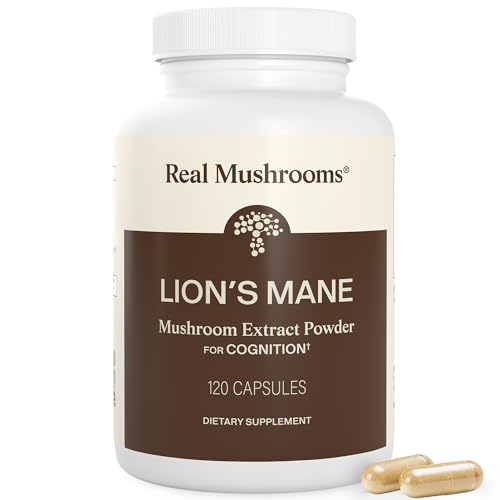
Five lion's mane picks compared on what actually matters: fruiting body versus mycelium, published beta-glucan figures, and how long 120 capsules really last at the label dose.

By Christopher CarrUpdated 15 min read
On this page
- Best organic lions mane supplement at a glance
- How three picks got cut before the shortlist
- Fruiting body or mycelium: which label wins?
- 1. Real Mushrooms Lion's Mane Capsules — Best overall
- 2. NUTRAHARMONY Lions Mane Supplement Capsules — Best budget pick
- 3. Double Wood Supplements Organic Lion's Mane Mushroom — Most versatile
- 4. Host Defense Lion's Mane — Best premium
- 5. NUTRAHARMONY Lions Mane Liquid — Best upgrade
- How long does a 120-count bottle actually last?
- What does "organic" mean on a lion's mane label?
- Capsules or liquid drops: which suits you?
- What the listings do not tell you
- The verdict
- FAQ
The best organic lions mane supplement is the Real Mushrooms Lion's Mane Capsules, a 120-count bottle whose listing states more than 30% beta-glucans per capsule, verified by third-party labs. If your budget is the binding constraint, the NUTRAHARMONY Lions Mane Supplement Capsules is the cheapest of the five here and still delivers 120 vegan caps. Getting this wrong is expensive in a quiet way: you take two capsules daily for two months, feel nothing, and blame the mushroom rather than the grain filler you actually bought.
Best organic lions mane supplement at a glance
| Pick | Form & count | Key label claim | Price |
|---|---|---|---|
Best overall Real Mushrooms Lion's Mane Capsules |
Capsules 120 ct |
Fruiting body only >30% beta-glucans claim |
Check Price |
Best budget pick NUTRAHARMONY Lions Mane Supplement Capsules |
Capsules 120 ct |
1200 mg per capsule 25% polysaccharides claim |
Check Price |
Most versatile Double Wood Supplements Organic Lion's Mane Mushroom |
Capsules 120 ct |
1,000 mg per capsule two-month supply claim |
Check Price |
Best premium Host Defense Lion's Mane |
Capsules 120 ct |
Mycelium on brown rice certified organic claim |
Check Price |
Best upgrade NUTRAHARMONY Lions Mane Liquid |
Liquid drops 2 fl oz |
72,000 mg strength claim USDA Organic claim |
Check Price |


How three picks got cut before the shortlist
Three listings dropped out of contention before I ranked anything, and the reasons are worth stating plainly.
- Blends. Any bottle mixing lion's mane with reishi, cordyceps and chaga hides how much lion's mane you actually get. If a label lists a 2,000 mg "mushroom complex" across eight species, the lion's mane share could be a rounding error.
- No form disclosed. Several listings never say whether you are buying fruiting body, mycelium, or mycelium grown on grain. That single omission decides more about a lion's mane supplement than milligram counts do.
- Gummies. Sugar-carrier formats crowd out extract. The picks below all deliver the mushroom in a capsule or a dropper, where the carrier is inert.
What survived is five bottles that each state a form, a count, and at least one measurable claim. Four are 120-count capsule bottles, which makes them directly comparable down the column. The fifth is a 2 fl oz liquid, included because swallowing capsules is a genuine barrier for some buyers and the alternative deserves a slot.
One honest caveat on the search itself. "Organic" is claimed by four of these five listings in some form, but only one uses the words USDA Organic. Amazon's results do not filter by certification, so treat organic as a claim you verify on the bottle photo rather than a promise this page can make for you.
Fruiting body or mycelium: which label wins?
Most guides to the best organic lions mane supplement compare milligrams. That is the wrong number to lead with. A 1,200 mg capsule of mycelium grown on rice and a 500 mg capsule of concentrated fruiting body extract are not the same product, and the bigger number belongs to the weaker one.
Here is the split that matters:
- Fruiting body is the visible white mushroom. Real Mushrooms and NUTRAHARMONY both claim fruiting body sourcing.
- Mycelium is the root-like network. Host Defense builds its listing around it, saying the mycelium is grown on organic brown rice substrate.
- Mycelium on grain ships to you with the grain still in the powder. Real Mushrooms makes that comparison directly, stating its capsules contain no starch, grains, or mycelium.
Beta-glucans are the compounds these arguments are really about. Real Mushrooms is the only pick here publishing a figure: more than 30% beta-glucans per capsule, third-party verified according to the listing. NUTRAHARMONY's capsules cite 25% polysaccharides instead, which is a broader, looser category that can include starch from a grain substrate. Double Wood and Host Defense publish no percentage at all.
That asymmetry is why the winner won. It's the only bottle in this group where the label commits to a number you could theoretically check.
1. Real Mushrooms Lion's Mane Capsules — Best overall
A 120-count bottle that publishes a beta-glucan percentage, which nothing else here does.
Best for: anyone who wants a published beta-glucan figure on the label Skip it if: you need the lowest cost per capsule in this set
This is the one buyers choose most often in this group, and the specification sheet explains why. The listing states 100% mushroom fruiting bodies with no starch, grains, or mycelium, then backs it with a stated figure of more than 30% beta-glucans per capsule, which Real Mushrooms says is verified by third-party labs. Every other pick here asks you to trust an unquantified word like "potent". This one names a threshold.
The dosing instruction is two capsules daily, so a 120-count bottle covers 60 days. Real Mushrooms adds that you can open capsules into food or a drink, which turns the same bottle into a powder without buying a second format. The bottle itself is small: 6.75 x 4.25 x 2 in and 2.35 oz, so it travels in a toiletry bag.
The trade-off is money and only money. This sits in the more expensive half of the set at fourth of five on price, and you get the same 120 capsules that the cheapest pick delivers. You are paying for the beta-glucan disclosure and the no-grain claim, not for extra capsules or a longer supply.
Pros:
- Only pick stating a beta-glucan percentage
- Fruiting body only, no grain filler claimed
- Third-party lab verification cited on the listing
- 120 capsules covers 60 days at the label dose
- Capsules can be opened into food or drink
Cons:
- Fourth of five on price for the same capsule count
- No warranty or guarantee published on the listing
- Only two sellers list it
- Beta-glucan figure is the brand's own claim, not independently shown to you
2. NUTRAHARMONY Lions Mane Supplement Capsules — Best budget pick
The cheapest of the five, still at 120 vegan capsules and a stated 1200 mg dose.

Best for: first-time buyers testing the category cheaply Skip it if: you want detailed published specifications
If you have never taken lion's mane and want to find out how you respond before committing, this is the sensible entry point. It's the cheapest here and matches the winner on capsule count at 120. The listing claims 1200 mg of lion's mane extract per capsule and describes it as fruiting body, standardised to 25% polysaccharides.
Read that polysaccharide figure carefully. Polysaccharides is a wider bucket than beta-glucans, and on a mushroom label it can include starch. NUTRAHARMONY's 25% and Real Mushrooms' 30% are therefore not comparing the same thing, even though the numbers sit close together. That gap is exactly the sort of detail that separates a budget pick from a first pick.
The published specifications are thin: a size, a count, and a model number, NH-LIONSMNCPS120. No weight, no dimensions, no capsule size. It's also the slowest seller of the four capsule bottles here, so it has less of a track record on Amazon than the top two. For a cheap first bottle that still names its form and its dose, none of that is disqualifying.
Pros:
- Cheapest pick in this comparison
- 120 vegan capsules, matching the winner's count
- Stated 1200 mg per capsule
- Fruiting body sourcing claimed on the listing
Cons:
- 25% polysaccharides is a looser measure than beta-glucans
- Fewest published specifications of any capsule pick here
- Slowest-selling of the four capsule bottles
- No stated dosing schedule to calculate supply length
3. Double Wood Supplements Organic Lion's Mane Mushroom — Most versatile
A 1,000 mg capsule at the second-cheapest position, with a two-month supply stated outright.

Best for: steady daily use at a low price position Skip it if: you want a stated beta-glucan percentage
This is the pick for someone who wants to take lion's mane every day for months without thinking about it. Double Wood states 1,000 mg per capsule across 120 capsules and says outright that the bottle lasts two months, which removes the arithmetic that other listings leave to you. It sits second-cheapest of the five, just above the budget pick.
The listing leans on process rather than potency. Double Wood says the product is manufactured and tested in the USA from globally sourced ingredients, and that it runs third-party testing. Note what that sentence does and does not promise: testing for safety is not the same as a published beta-glucan assay, and no percentage appears anywhere on the listing.
The bottle is compact at 3.1 x 1.5 x 2 in, the smallest footprint of the picks that publish dimensions. Model number is DWLMM. The set-wide comparison is straightforward: you get a clear milligram figure and a clear supply length, and you give up the compound disclosure that the winner provides. For long-term daily use at a low price, that's a defensible trade.
Pros:
- Second-cheapest of the five picks
- 1,000 mg per capsule clearly stated
- Two-month supply stated on the listing
- Smallest bottle footprint at 3.1 x 1.5 x 2 in
- Third-party testing claimed by the brand
Cons:
- No beta-glucan or polysaccharide percentage published
- Listing does not specify fruiting body or mycelium
- Lower milligram figure than either NUTRAHARMONY pick
- Only two sellers list it
4. Host Defense Lion's Mane — Best premium
The only mycelium-based pick here, and the only one naming a mycologist behind it.

Best for: buyers who specifically want mycelium-based lion's mane Skip it if: you only want fruiting body extract
Host Defense is the most expensive pick here and it takes a deliberately different position on the central question. The listing describes mushroom mycelium grown on organic brown rice substrate, certified organic, non-GMO, gluten-free, and grown in the USA. It also names its founder, mycologist Paul Stamets, and says third-party studies support mycelium plus fermented rice substrate.
Understand what you are choosing. Real Mushrooms explicitly positions against exactly this format, arguing that mycelium on grain leaves starch in the capsule. Host Defense argues the substrate is part of the active product. Both are brand claims, and neither publishes a beta-glucan percentage on its listing to settle it, which is the honest state of the evidence here.
Dosing is two capsules once daily with food or empty stomach, so 120 capsules covers 60 days at the same rate as the winner. The bottle measures 4.5 x 2.31 x 2.31 in. Model is NCHE120. Against the rest of this set, the position is uncomfortable: it costs the most, publishes no potency percentage, and delivers the same 120 capsules as a bottle costing much less.
Pros:
- Only mycelium-based option in this comparison
- Certified organic and non-GMO claimed
- Grown in the USA per the listing
- Clear dosing instruction of two capsules daily
- Names the mycologist behind the brand
Cons:
- Most expensive pick in this set
- No beta-glucan or polysaccharide percentage published
- Grain substrate remains in the product by design
- No extra capsules for the higher price position
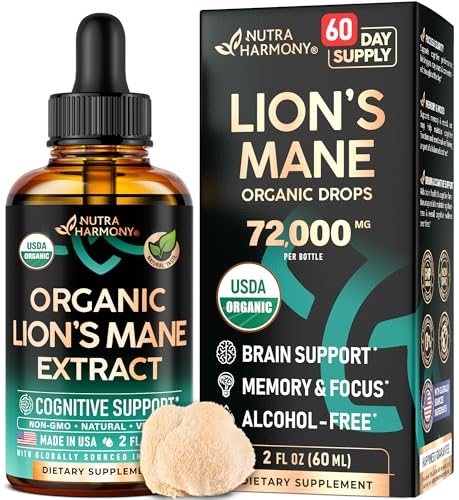
5. NUTRAHARMONY Lions Mane Liquid — Best upgrade
A 2 fl oz dropper for anyone who cannot or will not swallow capsules.
Best for: people who cannot swallow capsules Skip it if: you want a fixed, countable daily dose
This is the only pick in the set that is not a capsule, and it earns its place on that basis alone. Capsule aversion is common and real, and a dropper solves it without asking you to open pills into yoghurt every morning. The bottle holds 2 fl oz and sits in the middle of the five on price, third of five.
It's also the only pick claiming USDA Organic specifically rather than the general word organic, which is the strongest certification wording anywhere in this group. NUTRAHARMONY adds non-GMO, sugar-free and vegan, and describes cognitive support for concentration, sharpness and memory. The listing headlines a 72,000 mg figure for the bottle while separately citing a 1200 mg dose, which is the kind of mixed labelling that makes liquids hard to compare against capsules.
That's the core weakness. A capsule is a countable unit; a dropper depends on you filling it consistently, and the listing publishes no serving size in millilitres or drops. It's also the slowest seller of the five. Choose it because the format suits you, not because the milligram headline looks larger.
Pros:
- Only non-capsule format in this comparison
- USDA Organic claimed, the strongest certification wording here
- Sugar-free, non-GMO and vegan per the listing
- Mid-range price position of the five
Cons:
- No serving size published in millilitres or drops
- Headline strength figure and per-dose figure do not align cleanly
- Slowest seller of the five picks
- Dosing accuracy depends on you, not the capsule
How long does a 120-count bottle actually last?
Four of these five bottles hold 120 capsules, so supply length comes down entirely to the dose on the label.
- Real Mushrooms: two capsules daily, which the listing states. 120 capsules covers 60 days.
- Host Defense: two capsules once daily with or without food. Also 60 days.
- Double Wood: the listing says two months outright, which matches a two-a-day rate.
- NUTRAHARMONY capsules: 120 caps, no dosing schedule published, so you cannot calculate the supply from the listing.
Two months is therefore the working assumption for a 120-count bottle of the best organic lions mane supplement in almost every case. That matters for budgeting more than the sticker figure does, because a cheaper bottle taken at four capsules a day is not cheaper.
The liquid is a separate calculation you cannot make from the listing. A 2 fl oz bottle without a published serving size in drops or millilitres could last three weeks or three months depending on how you dose it. If predictable reordering matters to you, capsules win on that basis alone.
What does "organic" mean on a lion's mane label?
This is where the search term and the shelf drift apart. Four of these five listings use the word organic, but they use it in different ways and only one names a certifier.
- NUTRAHARMONY Liquid says USDA Organic explicitly. That is the strongest wording in the group.
- Host Defense says its mushroom mycelium is certified organic and grown in the USA.
- Real Mushrooms describes an organic mushroom extract and an organic mushroom supplement.
- Double Wood carries organic in the product title.
None of that is a substitute for reading the bottle. Amazon's search does not verify certification, so a page ranking for the best organic lions mane supplement may return products whose organic claim is broader than a USDA seal. Check the label photo for a certifier's name before you buy, and treat the word alone as marketing.
There's a second wrinkle worth knowing. Organic certification covers how the mushroom or substrate was grown. It says nothing about whether you're getting fruiting body or mycelium, and nothing about beta-glucan content. Certified organic mycelium on rice is still mycelium on rice. Those are three separate questions and only the first has a seal attached to it.
Capsules or liquid drops: which suits you?
Format is the second decision after fruiting body versus mycelium, and it's more personal than technical.
Capsules win on precision. Two capsules is two capsules every morning, and every capsule pick here publishes a milligram figure per capsule: 1200 mg for NUTRAHARMONY, 1,000 mg for Double Wood. Capsules also travel better, and the Real Mushrooms bottle at 2.35 oz and 6.75 x 4.25 x 2 in fits anywhere.
Drops win on two counts. First, swallowing. If capsules trigger a gag reflex or you're dosing someone who can't take pills, the argument ends there. Second, flexibility: you can split a dose across the day or add it to coffee without breaking anything open.
The trade-off is control. The NUTRAHARMONY liquid publishes no serving size, so you're estimating. Real Mushrooms offers a middle path by stating you can break capsules open into a meal or drink, which gives you a measured dose in a flexible format. That's the option I'd start with if you're unsure which side you fall on.
What the listings do not tell you
Three gaps run across all five of these listings, and knowing about them makes you a better shopper in this aisle.
No warranty or guarantee appears on any pick here. Not one of the five publishes return terms, a satisfaction guarantee, or a shelf-life date in its specifications. For a consumable, that's normal. It also means you have no stated recourse if the bottle doesn't suit you.
Extraction method is mostly absent. Hot water extraction, dual extraction and simple powdering produce different products from the same mushroom. Only the liquid implies an extraction by its format. The capsule listings describe extract without saying how it was made.
Third-party testing is claimed, not shown. Real Mushrooms says its beta-glucan figure is lab-verified. Double Wood says it runs rigorous third-party testing. Neither publishes a certificate of analysis in the listing. Ask the brand for one if the number matters to your decision, and be prepared for it to matter less to them than to you.
The verdict
At the entry tier, the NUTRAHARMONY Lions Mane Supplement Capsules is the pick. It's the cheapest of the five, delivers the same 120 capsules as bottles costing considerably more, and states a 1200 mg dose with fruiting body sourcing. What you give up is disclosure: 25% polysaccharides is a looser measure than beta-glucans, and the published specifications amount to a size, a count and a model number.
In the middle, the Double Wood Supplements Organic Lion's Mane Mushroom is the steady daily choice. Second-cheapest, 1,000 mg per capsule, and a two-month supply stated plainly on the listing so you know what you're reordering and when.
At the premium end, Real Mushrooms takes it, and it's the winner overall. It is the only bottle in this comparison publishing a beta-glucan percentage, stating more than 30% per capsule with third-party verification, and the only one explicitly excluding starch, grains and mycelium. Host Defense costs more and delivers the same 120 capsules with no potency percentage published, so it makes sense only if you specifically want mycelium on rice rather than fruiting body. The cutoff is simple: if a stated compound percentage matters to you, pay for Real Mushrooms. If it doesn't, don't pay premium prices for a bottle that omits it.
FAQ
Is an organic lions mane supplement worth the extra cost?
An organic lions mane supplement is worth the extra cost when the organic claim comes with something else attached. Real Mushrooms pairs it with a stated beta-glucan figure above 30%. The NUTRAHARMONY liquid pairs it with a USDA Organic claim. Organic on its own, with no potency disclosure and no form stated, buys you a growing standard rather than a stronger product.
Which offers better value, the cheapest capsules or the winner?
Better value between the cheapest capsules and the winner depends on what you need proven. Both are 120-count bottles, so you get identical capsule counts. NUTRAHARMONY costs the least here and states 1200 mg per capsule. Real Mushrooms costs more and publishes a beta-glucan percentage plus a no-grain claim. Pay the difference only if the compound number matters to you.
What is the difference between fruiting body and mycelium?
The difference between fruiting body and mycelium is which part of the mushroom you swallow. Fruiting body is the visible white mushroom, claimed by Real Mushrooms and NUTRAHARMONY. Mycelium is the root network, and Host Defense grows its mycelium on organic brown rice that stays in the capsule. Real Mushrooms markets directly against that, stating no starch, grains or mycelium.
Real Mushrooms or Host Defense for brain support?
Real Mushrooms or Host Defense comes down to your view on substrate. Both are 120-count bottles dosed at two capsules daily, so 60 days each. Real Mushrooms publishes a beta-glucan figure above 30% and excludes grain. Host Defense is the most expensive pick here, includes brown rice substrate by design, and publishes no percentage. Choose Host Defense only if you want mycelium specifically.
What mistake do first-time lion's mane buyers make most?
The mistake first-time lion's mane buyers make most is chasing the biggest milligram number. A 1200 mg capsule of grain-grown mycelium can contain less active compound than a smaller fruiting body extract capsule. Look for a beta-glucan percentage rather than a total weight, and note that polysaccharides is a broader category that may include starch from the growing substrate.
Start with the form question, not the price. Decide whether you want fruiting body or mycelium, because that single choice eliminates most of the shelf before cost enters the conversation. If you land on fruiting body and you want a number you can point to, Real Mushrooms is the default: 120 capsules, 60 days at two a day, and a stated beta-glucan figure above 30% that nothing else here matches. If you're simply finding out how lion's mane suits you, buy the cheapest bottle with a stated form, take it for the full two months, and judge from there.