Best Organic Halal Ashwagandha for Tight Budgets

Five organic ashwagandha bottles compared on dose, capsule count and what the certifications actually cover. NaturaLife Labs takes the top spot on 2,100 mg per serving, with clear conditions where the other four win instead.
By Christopher CarrUpdated 14 min read
On this page
- Best organic halal ashwagandha at a glance
- How I screened these five organic ashwagandha bottles
- Does organic certification tell you anything about halal status?
- 1. NaturaLife Labs Organic Ashwagandha 2100 mg per Serving — Best overall
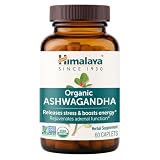
- 2. Himalaya USDA Organic Ashwagandha Root — Most versatile
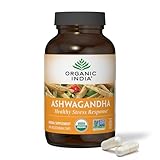
- 3. ORGANIC INDIA Ashwagandha Capsules — Best premium
- 4. Garden of Life Organic Ashwagandha with Probiotics & Ginger — Best minimal setup
- 5. AyBet Organic Irish Sea Moss Capsules 120 Count — Best upgrade
- Root powder or standardized extract: which dose actually matters?
- How long does one bottle really last?
- What the listings do not tell you about capsule format
- The verdict
- FAQ
The best organic halal ashwagandha in this group is NaturaLife Labs Organic Ashwagandha, which packs 2,100 mg per serving into a 100-capsule bottle at the cheapest price position of the five. If you'd rather have a documented extraction method and published testing counts, Himalaya's 670 mg organic caplets are the better pick. The specification that splits this field is not the brand story. It's how much ashwagandha the label actually commits to per serving, and whether that figure appears in the listing at all.
Two of these five don't publish a milligram figure anywhere. That's the fault line.
Best organic halal ashwagandha at a glance
| Pick | Dose per serving | Capsules per bottle | Price |
|---|---|---|---|
| 2,100 mg claim | 100 | Check Price | |
Most versatile Himalaya USDA Organic Ashwagandha Root |
670 mg | 60 caplets | Check Price |
Best premium ORGANIC INDIA Ashwagandha Capsules |
Not stated | 180 | Check Price |
Best minimal setup Garden of Life Organic Ashwagandha with Probiotics & Ginger |
600 mg claim | 60 | Check Price |
Best upgrade AyBet Organic Irish Sea Moss Capsules 120 Count |
Blend, not stated | 120 | Check Price |


How I screened these five organic ashwagandha bottles
I worked from the published listing data only: specifications, manufacturer feature claims, capsule counts, bottle dimensions and where each product sits in this set on price. No taste tests, no trial bottles. Just the numbers each brand is willing to print.
Three things came out of that comparison:
- Organic certification is near-universal here. Four of the five state USDA Organic somewhere in their claims. It's table stakes in this category, not a differentiator.
- Dose disclosure is not universal. Only three of the five name a milligram figure. That gap matters more than any label badge.
- Only one product in the set is not primarily an ashwagandha supplement. The AyBet capsules are a 16-ingredient sea moss blend that includes ashwagandha, and its category is blended vitamin and mineral supplements rather than herbal ashwagandha.
I kept it in anyway, because a real slice of shoppers searching for the best organic halal ashwagandha are actually looking for a combination formula. But it's ranked last for a reason, and that reason is transparency about how much ashwagandha you're getting.
Bottle size also shaped the ranking. Capsule counts across the five run from 60 to 180, a three-fold spread. That's the difference between reordering six times a year and reordering twice.
Does organic certification tell you anything about halal status?
Short answer: no. Organic certification tells you about farming inputs and processing aids. It says nothing about halal compliance, and the two audits are unrelated.
Of these five listings, only the AyBet sea moss capsules carry an explicit halal claim in the product title. The other four are silent on it. Three do state vegan and gluten-free, which rules out gelatin capsule shells in those cases, and gelatin is usually the sticking point for a capsule supplement.
So here's the honest position. If halal certification is a firm requirement rather than a preference, none of the four dedicated ashwagandha products in this set publish it, and I'm not going to pretend otherwise. What you can do:
- Check whether the capsule shell is listed as vegan or plant-based, which several here are
- Look for a certifying body named on the bottle itself, not in the listing copy
- Contact the brand directly for a current certificate, since certifications lapse and renew
The best organic halal ashwagandha for your situation may come down to one email to a manufacturer. That's not a satisfying answer, but it's the accurate one.
1. NaturaLife Labs Organic Ashwagandha 2100 mg per Serving — Best overall
The highest published dose in this set, in the largest single-herb bottle, at the cheapest price position of the five.
Best for: anyone who wants the highest published dose per serving at the lowest price position Skip it if: you want a clinically studied branded extract
Three numbers make this the default pick. It's the cheapest of the five. It holds 100 capsules, more than any other dedicated ashwagandha bottle here. And NaturaLife Labs states 2,100 mg per serving, which is more than three times the figure Himalaya prints and roughly three and a half times Garden of Life's stated 600 mg.
The composition claim is the more interesting part. NaturaLife says the serving combines organic root powder, a standardized root extract at 2.5% withanolides, and organic black pepper. That blend of whole root plus standardized extract is what the listing calls full spectrum, and it's the only product here that names a withanolide percentage at all. The brand also states no fillers, no magnesium stearate and no dioxides, with USDA Certified Organic, non-GMO, gluten-free and vegan claims across the board.
It also happens to be the one buyers choose most often in this group by a wide margin. Where it loses: there's no clinical trial documentation attached, no stated extraction method, and no halal certification in the listing. You're trading brand paperwork for dose and price.
Pros:
- Highest published dose in this set at 2,100 mg per serving
- Only pick naming a withanolide percentage
- 100 capsules, largest single-herb bottle here
- Cheapest of the five
- Stated free of fillers and magnesium stearate
Cons:
- No clinical study documentation published
- No halal certification stated in the listing
- Extraction method not disclosed
- Only two sellers list it
2. Himalaya USDA Organic Ashwagandha Root — Most versatile
The pick with the most published detail about how the product is made and checked.
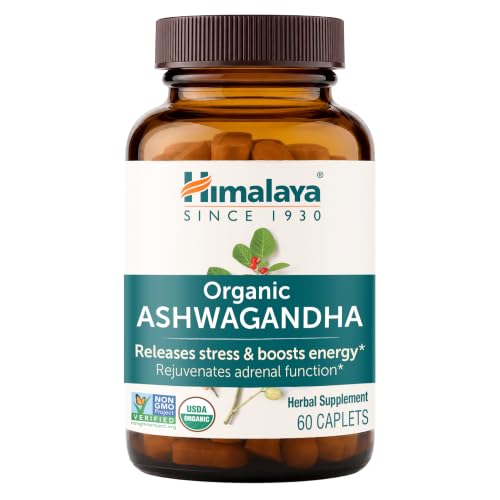
Best for: shoppers who want published testing detail and a documented extraction method Skip it if: you need more than 60 caplets per bottle
Himalaya is the only product here that tells you how the ashwagandha was pulled out of the root. The listing states water and CO2 extraction with no harsh solvents, which is a real process disclosure rather than a wellness adjective. Himalaya also claims every lot passes more than 25 tests for identity, purity and safety, including 7 for microbial safety, and says the product has been evaluated in 4 clinical trials.
The dose is 670 mg per caplet across 60 caplets, described as a 60-day supply. That's a modest figure next to NaturaLife's 2,100 mg, and it sits mid-range on price for this set. The bottle is compact at 2 x 2 x 3.56 in and weighs 6.08 oz, heavier than you'd expect for 60 caplets because Himalaya packages in premium amber glass rather than plastic. It's also USDA Organic, vegan, gluten-free and Non-GMO Project Verified, and it's been on the market since 2012.
The trade-off against NaturaLife is blunt: you get far more documentation and far less ashwagandha per serving, in a smaller bottle, for more money.
Pros:
- Only pick stating water and CO2 extraction
- Claims 25+ tests per lot for identity and purity
- Amber glass packaging rather than plastic
- Compact 2 x 2 x 3.56 in bottle
- Non-GMO Project Verified
Cons:
- Smallest count in the set at 60 caplets
- 670 mg is well below the top dose here
- Glass bottle at 6.08 oz is heavier to store
- No halal certification stated
3. ORGANIC INDIA Ashwagandha Capsules — Best premium
The biggest bottle in the group by a clear margin, and the longest gap between reorders.

Best for: long-run daily users who hate reordering Skip it if: you want the milligram dose printed in the listing
180 capsules is triple what Himalaya and Garden of Life give you, and 80% more than NaturaLife. If you already take ashwagandha daily and know it agrees with you, that capsule count is the single most practical advantage in this whole comparison. The bottle measures 4.75 x 2.46 x 2.46 in and weighs 0.6 lb, so it's the tallest here but still fits a standard cabinet shelf.
ORGANIC INDIA describes it as vegan root, gluten-free, and frames the herb in Ayurvedic terms, calling ashwagandha a rasayana herb. The claims cover stress response, sleep quality without sedation, sustained energy, cognitive support and adrenal function. Read those as the manufacturer's positioning rather than measured outcomes.
Here's my problem with it. For a product at the most expensive end of this set alongside AyBet, the listing never states how many milligrams of ashwagandha are in a capsule. You're buying count and brand heritage, not a disclosed dose. That's a strange gap when the cheapest pick here leads with its number. The product has been listed since 2016, so this isn't a new entrant still filling in its copy.
Pros:
- Largest count in the set at 180 capsules
- Longest stretch between reorders of any pick here
- Vegan capsule and gluten-free
- Established listing dating to 2016
Cons:
- No milligram dose stated anywhere in the listing
- Sits at the most expensive end of this set
- No withanolide percentage published
- No halal certification stated
4. Garden of Life Organic Ashwagandha with Probiotics & Ginger — Best minimal setup
One tablet a day, with digestion support built in, and the second-cheapest price position here.

Best for: people who want one tablet a day and nothing to think about Skip it if: you want a high-milligram ashwagandha dose
Garden of Life is the simplest routine in the group. 60 tablets, 60 days, one a day, done. It states 600 mg of organic ashwagandha root per tablet, plus a 4 mg blend of probiotics and organic fermented ginger root aimed at digestion and absorption. It's the only pick in this set pairing the herb with a probiotic, which matters if capsules have upset your stomach before.
The certification list is the longest here: USDA Organic, Non-GMO Project Verified, NSF Certified Gluten Free, Vegan, and Kosher. Kosher is not halal, and I won't blur the two. But it does confirm a third-party audit trail exists for this facility, which is more than most of this set shows. The bottle runs 4.44 x 2.47 x 2.47 in and 8 oz, the heaviest here for only 60 tablets.
At 600 mg, it publishes the lowest stated dose of the three that name one. The trade-off against NaturaLife is stark: roughly a quarter of the ashwagandha per serving, in a bottle with 40 fewer capsules, for more money. What you get back is the probiotic pairing and the certification stack.
Pros:
- Longest certification list in the set
- Only pick with a probiotic and fermented ginger blend
- Simple one-tablet daily routine
- Second-cheapest of the five
Cons:
- Lowest stated dose at 600 mg
- Only 60 tablets per bottle
- Heaviest bottle here at 8 oz for the smallest count
- Kosher certification is not halal certification
5. AyBet Organic Irish Sea Moss Capsules 120 Count — Best upgrade
The only pick with a halal claim in its title, but ashwagandha is one of sixteen ingredients.
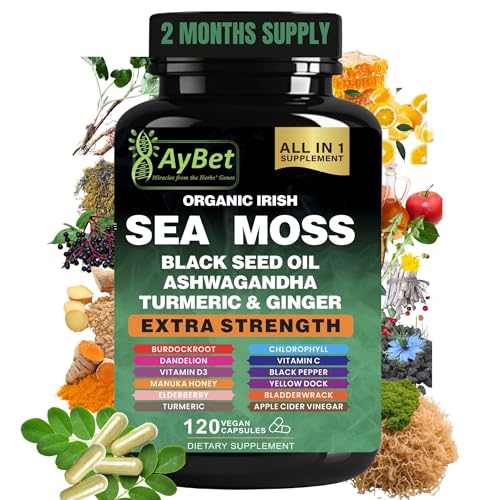
Best for: shoppers who want ashwagandha inside a broader mineral blend Skip it if: ashwagandha is the only thing you're buying for
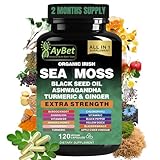
This is the outlier, and the reason it's here at all is the word halal printed in its own title. AyBet states organic, vegan and halal for a 16-in-1 formula built around Irish sea moss, with black seed oil, ashwagandha, turmeric, ginger, bladderwrack, burdock root and added vitamin D3. 120 capsules in a 4.2 x 2.2 x 2.2 in bottle.
If you were already planning to take sea moss and ashwagandha separately, consolidating into one capsule is a genuine convenience. The mineral claims centre on iodine, magnesium, potassium, calcium and zinc occurring naturally in sea moss.
The catch is unavoidable. In a 16-ingredient blend, no individual ingredient dose is published, so you have no idea how much ashwagandha you're taking. Compare that to NaturaLife's stated 2,100 mg and the gap is obvious. It's also at the most expensive end of this set, it sits in the blended vitamin and mineral category rather than herbal ashwagandha, and it's the slowest seller of the five by a very large margin. Buy it as a sea moss product with a bonus, not as your ashwagandha.
Pros:
- Only pick stating halal on the label
- 120 capsules, second-largest count here
- Consolidates 16 ingredients into one capsule
- Compact 4.2 x 2.2 x 2.2 in bottle
Cons:
- No ashwagandha dose published at all
- Ashwagandha is one of sixteen ingredients
- Most expensive end of this set
- Slowest seller of the five by a wide margin
- Not categorised as an ashwagandha supplement
Root powder or standardized extract: which dose actually matters?
Most guides to the best organic halal ashwagandha compare total milligrams and stop. That's the wrong lens, and here's why.
Ashwagandha's active compounds are withanolides. A standardized extract states what percentage of the material is withanolides. Whole root powder doesn't, because the figure varies with the plant. So a big milligram number built mostly from root powder is not automatically stronger than a smaller number built from a concentrated extract.
Only NaturaLife names a percentage here: 2.5% withanolides in its standardized extract portion, blended with whole root powder. Himalaya says root powder plus root extract without a percentage. Garden of Life says organic ashwagandha extract at 600 mg. ORGANIC INDIA and AyBet publish neither a percentage nor, in ORGANIC INDIA's case, a milligram figure.
Practical rule when you're comparing any two bottles:
- A stated withanolide percentage beats a big unqualified milligram number
- A milligram number with no percentage beats no number at all
- No number and no percentage means you're buying the label design
That hierarchy is the single most useful thing you can carry into this category.
How long does one bottle really last?
Counts here run 60, 60, 100, 120 and 180. At one serving a day, that's roughly two months to six months per bottle, which changes your reorder rhythm dramatically.
- 60 count (Himalaya, Garden of Life): about two months, six orders a year
- 100 count (NaturaLife): a little over three months
- 120 count (AyBet): about four months
- 180 count (ORGANIC INDIA): about six months, two orders a year
Two caveats. Himalaya and Garden of Life both describe theirs as a 60-day supply, which lines up with one unit daily. NaturaLife's 2,100 mg figure is per serving, and a serving may be more than one capsule, so treat 100 capsules as the hard number and the day count as an estimate you should confirm on the label.
Bottle footprint follows count. ORGANIC INDIA is tallest at 4.75 in, Himalaya shortest at 3.56 in. If your cabinet shelf is tight, that inch matters more than you'd think.
What the listings do not tell you about capsule format
Three of these are described as capsules, one as caplets, one as tablets. That distinction gets glossed over constantly, and it affects real things.
Caplets and tablets are compressed powder with a coating. They tend to be smaller for the same material and they don't need a shell, which sidesteps the gelatin question entirely. Himalaya's are caplets. Garden of Life's are tablets. Capsules use a shell, and whether that shell is plant-based or animal-derived is the question that decides halal suitability. Vegan capsules use plant cellulose.
What the listings here won't tell you:
- The exact capsule shell material by name
- Whether the facility handles animal-derived ingredients
- Whether any halal certification has been renewed recently
- Serving size in capsules for the products that quote a per-serving milligram figure
For anyone whose priority is genuinely the best organic halal ashwagandha rather than just organic, that last list is your checklist for one message to the brand before you commit to a 180-capsule bottle.
The verdict
If your priority is dose per dollar, NaturaLife Labs Organic Ashwagandha wins this comparison outright. It's the cheapest of the five, it holds 100 capsules, it states 2,100 mg per serving, and it's the only pick that names a withanolide percentage at 2.5%. Nothing else here matches that combination, and it's the pick buyers reach for most often in this group.
If your priority is documented process, Himalaya USDA Organic Ashwagandha is the better buy. Water and CO2 extraction, a claimed 25-plus tests per lot, 4 clinical evaluations and amber glass packaging give you a paper trail that NaturaLife simply doesn't publish, and 670 mg per caplet is a sensible daily figure.
The cutoff is capsule count against dose disclosure. If you need six months in one bottle and you're comfortable without a stated milligram figure, ORGANIC INDIA's 180 capsules is the only pick that gets you there. If you want the number on the label, you're choosing between NaturaLife's 2,100 mg, Himalaya's 670 mg and Garden of Life's 600 mg, and none of those bottles exceeds 100 units.
On halal specifically: AyBet is the only listing here that claims it, and ashwagandha is one ingredient in sixteen. That's the honest state of this set.
FAQ
Is organic halal ashwagandha worth paying more for?
Organic halal ashwagandha is worth the premium only if both certifications are actually printed on the bottle you receive. Organic certification covers farming inputs and processing aids. Halal certification covers a separate audit chain, usually hinging on capsule shell material. Paying extra for a product that claims one and implies the other gets you half of what you wanted.
Which offers better value, NaturaLife Labs or ORGANIC INDIA?
Better value between NaturaLife Labs and ORGANIC INDIA depends on what you're counting. NaturaLife gives you 100 capsules, a stated 2,100 mg per serving and a 2.5% withanolide figure at the cheapest position here. ORGANIC INDIA gives you 180 capsules but publishes no milligram dose at all. For disclosed strength, NaturaLife. For sheer count, ORGANIC INDIA.
How many milligrams of ashwagandha per serving should I look for?
Milligrams of ashwagandha per serving matter less than the withanolide percentage behind them. These five range from a stated 600 mg to 2,100 mg, with two publishing nothing. A smaller standardized extract dose can carry more active compound than a larger scoop of plain root powder. Look for the percentage first, then the milligram figure.
Are ashwagandha capsules suitable for a vegan diet?
Ashwagandha capsules are suitable for vegan diets only when the listing states it, because standard capsule shells can be gelatin-based. NaturaLife, Himalaya, ORGANIC INDIA, Garden of Life and AyBet all state vegan in their claims here. Himalaya's caplets and Garden of Life's tablets avoid the shell question entirely, since compressed formats need no capsule at all.
What's the biggest mistake buyers make in this category?
The biggest mistake buyers make is treating a blended supplement as an ashwagandha supplement. AyBet's 16-in-1 sea moss formula contains ashwagandha, but no individual ingredient dose is published, so you cannot know your intake. If ashwagandha is your reason for buying, choose a product where the herb is the headline and the number is printed.
Start with NaturaLife Labs unless one of the three conditions above applies to you: you want extraction documentation, you want six months per bottle, or you want a probiotic in the same tablet. Then take five minutes before you order and email the brand about halal certification, because no dedicated ashwagandha listing in this set publishes it and that's a question only the manufacturer can answer. The reason NaturaLife earns the default slot isn't the 2,100 mg headline on its own. It's that among five bottles, it's the only one willing to tell you what percentage of that material is actually doing the work.