Best High Potency Ankle Brace for Kids Who Play Hard

A ranked look at six youth ankle braces, judged on strap design, weight, sizing method and how well each fits inside a shoe. Includes the one pick built for a diagnosed sprain rather than everyday support.

By Christopher CarrUpdated 19 min read
On this page
- Best high potency ankle brace for kids at a glance
- How I screened the field down to six
- What does "high potency" actually mean for an ankle brace?
- Sleeve, figure-8 or lace-up: which does your kid need?
- 1. BraceUP Kids Ankle Brace — Best overall
- 2. Med Spec ASO Ankle Stabilizer Lace Up Ankle Brace Sprain — Best premium
- 3. Neo-G Ankle Brace for Kids — Best for heavy use
- 4. Honoson 2 Pcs Kids Ankle Brace Youth Ankle Support — Best for families
- 5. Luwint Kid Compression Ankle Brace Sock Support — Most versatile
- 6. COMFORCE Ankle Support Brace — Best budget pick
- Will it fit inside a cleat or a school shoe?
- How do you size a brace for a foot that keeps growing?
- What the listings don't tell you
- The verdict
- FAQ
The best high potency ankle brace for kids is the BraceUP Kids Ankle Brace, a 1.76 oz slip-on sleeve with adjustable hook-and-loop straps and an open heel that clears the back of a shoe. If your child has an actual diagnosed sprain, the Med Spec ASO Ankle Stabilizer in XX-Small is the stronger buy at 4.97 oz with figure-8 straps and a 6 month limited warranty.
Price tiers here map neatly onto structure. The cheapest picks are pull-on knit sleeves. The middle of the field adds adjustable straps. The top of the field adds a lace-up shell and cross-over strapping, which is a different product doing a different job. Knowing which tier you're shopping decides everything else.
Best high potency ankle brace for kids at a glance
| Pick | Support type | Weight | Price |
|---|---|---|---|
Best overall BraceUP Kids Ankle Brace |
Sleeve + adjustable straps | 1.76 oz | Check Price |
Best premium Med Spec ASO Ankle Stabilizer |
Lace-up + figure-8 straps | 4.97 oz | Check Price |
Best for heavy use Neo-G Ankle Brace for Kids |
Wrap + figure-8 strap | 2.4 oz | Check Price |
Best for families Honoson 2 Pcs Kids Ankle Brace |
Neoprene + elastic wraps | 3.36 oz (pair) | Check Price |
Most versatile Luwint Kid Compression Ankle Brace Sock |
Knit compression sleeve | Pack of 2 | Check Price |
Best budget pick COMFORCE Ankle Support Brace |
Neoprene + adjustable strap | 2.08 oz | Check Price |



How I screened the field down to six
I started from every youth-sized listing in the Leg & Foot Supports > Ankle Braces category and compared the published specifications side by side. Weight, size, count, colour, model number, warranty. Then I read what each brand claims about fit and construction, and kept the claims separate from the numbers.
Three screens cut the list:
- A published fit range. A brace that says only "for kids" is unbuyable. I kept listings that give an ankle circumference, a shoe-size chart, a height range, or an arch measurement.
- A stated structure. Sleeve, wrap, strap, or lace-up. If the listing won't say how the support is delivered, you can't match it to the injury.
- A weight or a dimension. Bulk decides whether the brace goes in a shoe or in a drawer.
What survived splits cleanly into two families. Four are soft compression pieces with straps: BraceUP at 1.76 oz, COMFORCE at 2.08 oz, Neo-G at 2.4 oz, Honoson at 3.36 oz for the pair. Two are outliers. Luwint is pure knit with no strap at all. Med Spec ASO is a 4.97 oz lace-up shell in XX-Small, the only pick here with a warranty attached and the only one that reads as clinical hardware.
Set composition tells you something the individual listings don't. Only one of the six publishes a warranty. Only one arrives as two units in a colour-matched pair. Only two give a shoe-size chart rather than a circumference. Every single one lists just one seller, so there's no scrapping over which merchant to buy from.
What does "high potency" actually mean for an ankle brace?
Nothing, strictly. "High potency" is dosage language borrowed from supplements, and no brace listing in this set uses the phrase. Amazon's search treated it loosely, which means no product here is sold as high potency and I'm not going to pretend otherwise.
What you're really asking is how much restriction the brace delivers. That's the useful question, and it has a real answer you can read off the page.
Restriction comes from three things, in order of effect:
- Rigid or semi-rigid material. Only the Med Spec ASO has a structured shell with laces.
- Cross-over strapping. Figure-8 straps pull the ankle in two planes at once. Med Spec and Neo-G both name a figure-8 design.
- Compression alone. A knit sleeve like the Luwint applies pressure and warmth. It resists nothing.
So when someone searches for the best high potency ankle brace for kids, they usually want the second or third rung of that ladder, not the top. A 4.97 oz lace-up on a seven-year-old at recess is overkill that ends up abandoned in a cubby. A strapped sleeve at under 2.5 oz gets worn, and a brace worn is worth more than a brace rated.
Here's the trick with kids specifically: compliance beats capability. Weight and ease of fastening decide whether the thing stays on the foot for a full school day.
Sleeve, figure-8 or lace-up: which does your kid need?
Match the structure to the situation, not to the price.
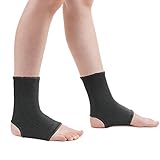
Pull-on knit sleeve. The Luwint is the only pure example here, sold as a pack of 2 in small. Open toe, open heel, machine washable per the listing. Use it for dance, cheer, gymnastics warm-ups and vague post-activity aches. It offers, in the brand's words, "light compression and flexibility" with minimal bulky seams.
Sleeve or wrap with adjustable straps. This is the middle of the field and where most kids land. BraceUP, COMFORCE and Honoson all use hook-and-loop or elastic wraps over a soft body. You can dial tension up for a game and down for the classroom. BraceUP's listing describes an open-heel design and breathable materials that fit inside most athletic shoes.
Figure-8 strapping. Neo-G adds a figure-8 strap over an adjustable compression wrap at 2.4 oz. Med Spec builds figure-8 straps into a lace-up shell. The brand says the straps provide "maximum control" and limit painful twists. That's a real step up in restriction and a real step up in fiddliness.
Lace-up shell. One pick only. The ASO Stabilizer in XX-Small measures 2.28 x 8.19 x 5.2 in with CoolFlex padding and a nylon body, and Med Spec positions it for sprain recovery and chronic instability. It's the answer when a clinician has actually looked at the ankle.
If nobody has diagnosed anything, start one rung lower than you think.
1. BraceUP Kids Ankle Brace — Best overall
The best high potency ankle brace for kids in everyday terms: a 1.76 oz strapped sleeve light enough that your child forgets it's on.
Best for: an active 6 to 11 year old who needs everyday support inside sports shoes Skip it if: your child has a diagnosed sprain and a doctor asked for rigid stabilisation
At 1.76 oz, this is the lightest brace in the set that still gives you adjustable tension. That combination is rarer than it sounds. The Luwint sleeve is light but has no strap. The Neo-G and COMFORCE both add straps and add weight. BraceUP splits the difference at model B904, size S, in blue.
The sizing information is the strongest published in this group. BraceUP states the range as roughly 3'3" to 4'11" tall, with two sizes covering it, and gives an ankle circumference figure starting at 7.1 in for XS. Height plus circumference is a better sizing pair than shoe size alone, because a child's foot length and ankle girth don't track together.
The brand describes a slip-on sleeve with hook-and-loop straps for customisable compression, an open-heel design, and breathable material meant to sit inside most athletic and everyday shoes. It names basketball, soccer, volleyball, running and playground use.
The trade-off against the rest of the set is ceiling. There's no figure-8 strap here, so the Neo-G restricts more in two planes, and the Med Spec restricts far more again. No published warranty either, which the ASO has. What you get instead is the pick most likely to actually be worn on a Tuesday.
Pros:
- Lightest strapped brace in this set at 1.76 oz
- Sizing given by both height and ankle circumference
- Open-heel design claimed to fit inside most athletic shoes
- Slip-on body with hook-and-loop straps, easy for a child to manage
- Reversible for left or right foot
Cons:
- No figure-8 strap, so less rotational control than Neo-G
- No published warranty, unlike the Med Spec ASO
- Sold as a single unit, so no spare for wash days
- Only one seller lists it
2. Med Spec ASO Ankle Stabilizer Lace Up Ankle Brace Sprain — Best premium
The only genuinely rigid pick here, and the one to buy when an actual sprain is on the table.

Best for: a teen or bigger kid recovering from a rolled ankle Skip it if: you want something a young child can fasten alone
This is the most expensive pick here and the heaviest at 4.97 oz, nearly three times the BraceUP. That weight is the structure. Model 264019 in XX-Small measures 2.28 x 8.19 x 5.2 in, with laces, figure-8 straps and a nylon body the brand says resists stretch.
It's also the only brace in the group with a stated warranty, at 6 months limited, and it sells faster than anything else in this set by a wide margin. Med Spec positions it for sprain recovery, ligament and tendon injuries, and chronic ankle instability, and says it's recommended by athletic trainers for basketball, volleyball, soccer and football. Treat that as the brand's positioning, not a verified outcome.
The XX-Small size is what puts it in a kids' guide at all. This is an adult product line scaled down, not a youth product, and nothing in the listing gives a child height or age range. You'll need to measure and check the manufacturer's chart rather than guess.
Against the rest of the field, the cost is convenience. Laces plus two straps take real time, and a young child won't manage it unsupervised before school. The other five all fasten in seconds. Buy this one for a specific injury, not as a general precaution.
Pros:
- Only pick here with a published warranty, at 6 months limited
- Lace-up shell plus figure-8 straps for the most restriction in this set
- Full dimensions published: 2.28 x 8.19 x 5.2 in
- CoolFlex padding and durable nylon named in the listing
- Bilateral, so it fits either ankle
Cons:
- Heaviest option at 4.97 oz, and the bulkiest inside a shoe
- Laces and two straps are slow, and hard for a young child alone
- No published child age, height or circumference range
- The most expensive pick here, for a size scaled down from an adult line
3. Neo-G Ankle Brace for Kids — Best for heavy use
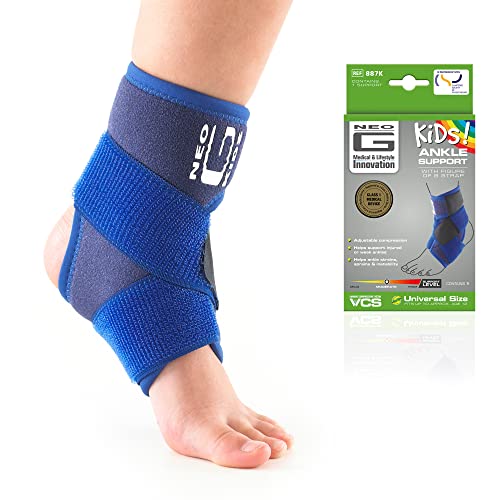
A figure-8 strap on a 2.4 oz body, which is the most restriction you can get here without going lace-up.
Best for: gymnastics and volleyball where a figure-8 strap earns its keep Skip it if: your child's ankle measures outside 6.3 to 7.9 in
Neo-G is the middle rung of the support ladder, and it publishes the numbers to prove it. Model 887K, One Size, 2.4 oz, 7.48 x 1.57 x 3.94 in. The listed fit is ankle joint circumference 6.3 in to 7.9 in, roughly ages 4 to 12.
The differentiator inside this set is that figure-8 strap layered over adjustable compression. Only the Med Spec also uses figure-8 strapping, and the Med Spec weighs more than twice as much. Neo-G says the added strap provides extra support and compression, and describes the base adjustment as controlled support with blood flow safety in mind. The listing calls it a Class 1 medical device and names juvenile arthritis, aching joints and injury recovery, plus gymnastics, basketball and volleyball.
Neo-G is also refreshingly honest about footwear. Its own listing warns the brace may be unsuitable for tight-fitting shoes with little flexibility, such as tight boots or formal shoes. That's a real constraint the other soft picks skip over.
The trade-off is the single One Size design. There's no smaller or larger variant to grow into, so a child near either end of the 6.3 to 7.9 in window will outgrow or under-fill it quickly. It's also the slowest seller in this group.
Pros:
- Figure-8 strap at just 2.4 oz, the lightest two-plane option here
- Published ankle circumference range of 6.3 to 7.9 in
- Full dimensions listed: 7.48 x 1.57 x 3.94 in
- Fits left or right ankle, unisex
- Listing states footwear limits plainly
Cons:
- One Size only, with no room to size up or down
- Circumference window of 6.3 to 7.9 in is narrow for ages 4 to 12
- Brand warns against tight boots and formal shoes
- Slowest seller of the six, and no published warranty
4. Honoson 2 Pcs Kids Ankle Brace Youth Ankle Support — Best for families
Two braces in one order, sized by shoe size, which solves the sibling problem and the laundry problem at once.

Best for: two siblings, two sports, or one brace in the wash Skip it if: you need shoe-size sizing to match an unusually wide foot
Count is the spec that matters here. You get 2 braces, 3.36 oz for the pair, in black, size S. Only the Luwint also arrives as a pair, and the Luwint has no straps. So Honoson is the only strapped, adjustable option in this set that ships two.
That count changes how you use it. One brace on each ankle for a kid whose instability isn't one-sided. Or one at home and one in the sports bag, which is how most of these get lost. Or two children sharing a size.
Sizing runs off shoe size rather than circumference: the listing states S fits shoe sizes 3 to 5, M fits 5 to 7, L fits 7 to 9. That's easier for a parent to check than wrapping a tape measure around a squirming ankle, though it's less precise about girth. Construction is neoprene, which Honoson calls skin friendly and breathable, with elastic adjustable wraps. The brand names juvenile arthritis, joint soreness and sprain recovery, plus basketball, gymnastics and running.
The trade-off is structural. No figure-8 strap and no published dimensions, so you can't judge bulk before it arrives. It also sits at a premium price position despite offering less restriction than the Neo-G, which is the harder pill here.
Pros:
- Ships as a pack of 2, the only strapped pair in this set
- Shoe-size chart across S, M and L is easy to check
- Neoprene body with elastic adjustable wraps
- Combined pair weight of just 3.36 oz
- Black finish hides use better than lighter colours
Cons:
- No figure-8 strap, so less rotational control than Neo-G
- Shoe-size sizing says nothing about ankle girth
- No published dimensions, so shoe fit is a guess
- A premium price position for mid-tier support, and no warranty listed
5. Luwint Kid Compression Ankle Brace Sock Support — Most versatile
A strapless knit sleeve in a pack of 2, thin enough to disappear under a dance shoe or a cleat.

Best for: dance, cheer and low-grade aches where bulk is the enemy Skip it if: you need adjustable strap tension
Luwint takes the opposite approach to everything else here. No straps, no hook-and-loop, no shell. Just a knitted compression sleeve, size small, count of 2, in black. The listing describes a pull-on design with an open toe and open heel, machine washable, built to minimise bulky seams for a smoother feel under shoes.
That makes it the most footwear-agnostic pick in the set. Where Neo-G openly warns about tight boots, a seamless knit sleeve goes wherever a sock goes. Luwint names basketball, running, soccer, gymnastics, dance, hiking and cheer, and describes the aim as targeted compression that stays put without sliding.
It's also the second-cheapest here and arrives as a pair, which makes it the most sensible thing to buy if you're unsure whether your child needs a brace at all. A sleeve is a low-commitment starting point.
Now the honest part. Compression is not stabilisation. There's no mechanism in a knit sleeve to resist an ankle rolling, so if the concern is a repeat sprain, this is the wrong tier. Luwint also publishes fewer specifications than any other pick here: no weight, no dimensions, and sizing that points you to a chart rather than naming a circumference. That's the price of the low price.
Pros:
- Pack of 2, so one stays clean while the other's worn
- Strapless knit sleeve fits under nearly any footwear
- Open toe and open heel design
- Machine washable per the listing
- Second-cheapest pick in this set
Cons:
- No straps at all, so no adjustable tension and little roll resistance
- No published weight or dimensions
- Sizing relies on an external chart rather than a stated measurement
- Wrong tier entirely for a diagnosed sprain
6. COMFORCE Ankle Support Brace — Best budget pick
The cheapest of the six, and a 2.08 oz neoprene brace with a strap is a fair amount of support for the least outlay here.

Best for: a first brace, or a spare for the sports bag Skip it if: your child's arch circumference is over 11 in
COMFORCE is the cheapest pick here and it doesn't feel like a stripped-down one. Model CFO113, 2.08 oz, black, single unit. That's lighter than the Neo-G and only marginally heavier than the BraceUP, which puts it firmly in the wearable band.
The sizing method is unusual and worth understanding. Rather than ankle circumference or shoe size, COMFORCE gives one figure: an arch circumference of up to 11 in, one size fits most, reversible for either ankle. Measure around the arch of the foot before ordering, because a single upper bound is all you get.
The brand describes 3D knitting for a softer, more flexible fit, a breathable neoprene body meant to keep muscles warm, and a quick on/off design with a visible adhesive stamp for easy use. It names ligament tears, tendon injuries, high ankle sprains, weakness and instability among the things it aims to help with. Those are the manufacturer's claims about intent, not proof of outcome.
The trade-offs are visible in what's missing. No published dimensions, no warranty, no size specification beyond that 11 in ceiling, and the slowest sales of any pick in this group by a very large margin. It's also a single brace where the Honoson and Luwint both give you two.
Pros:
- Cheapest of the six
- Light at 2.08 oz, close to the BraceUP
- Single 11 in arch measurement makes ordering simple
- Breathable neoprene with 3D knit construction claimed
- Reversible for left or right ankle
Cons:
- No published dimensions and no size spec beyond an 11 in ceiling
- One size fits most, so nothing for larger or smaller feet
- Sold singly while two rivals ship pairs
- Slowest-selling pick in this set, with no warranty listed
Will it fit inside a cleat or a school shoe?
This is where most kids' braces fail, and the listings are uneven about it.
Three design cues tell you a brace will clear a shoe. An open heel, because that's the bulkiest point. A stated low weight. And no rigid shell. BraceUP names an open-heel design and says it fits inside most athletic and everyday shoes. Luwint has an open toe and open heel and describes minimised seams. Those two are the safest bets for a tight cleat.
Two are honest about limits. Neo-G says it fits a variety of footwear but may be unsuitable for tight boots or formal shoes. Med Spec says the figure-8 shell fits inside most shoes, but at 4.97 oz and 2.28 in thick, expect to size the shoe up or loosen the laces significantly.
Two publish nothing useful. Honoson and COMFORCE give no dimensions at all, so you're judging by weight alone: 3.36 oz for the Honoson pair and 2.08 oz for the COMFORCE.
A practical order of operations:
- Measure the ankle or arch first, before you look at braces.
- Check the shoe your child actually wears for the sport, not their roomiest pair.
- If the shoe is a snug cleat, stay under about 2.5 oz.
- If the brace has laces, plan on a half size up in the shoe.
How do you size a brace for a foot that keeps growing?
Kids outgrow braces faster than they wear them out, and the six picks handle that in four different ways.
- Height plus circumference. BraceUP, roughly 3'3" to 4'11" with XS starting at 7.1 in ankle circumference. Two sizes cover the range, so there's an upgrade path.
- Ankle circumference only. Neo-G, 6.3 in to 7.9 in in One Size, described as roughly ages 4 to 12.
- Shoe size. Honoson, with S at shoe sizes 3 to 5, M at 5 to 7, L at 7 to 9. Three steps to grow through.
- Arch circumference ceiling. COMFORCE, up to 11 in, one size.
Circumference is the most reliable of the four, because it measures the thing the brace wraps. Shoe size is the most convenient and the least precise. A single ceiling figure like COMFORCE's tells you when to stop, not where to start.
Most shoppers miss the second half of this: whether a size ladder exists. Honoson's S/M/L and BraceUP's two-size range both let you rebuy the same brace one step up next season, which matters when your child has learned to tolerate a particular fit. Neo-G, COMFORCE and Luwint's small are one-shot sizing. Med Spec's XX-Small is the bottom of an adult ladder, so it goes up but never down.
Measure with a soft tape around the narrowest part of the ankle, standing, at the end of the day when the foot is at its largest.
What the listings don't tell you
Four blanks in this set are worth knowing about before you order.
Durability has almost no evidence. One brace in six publishes a warranty: the Med Spec ASO at 6 months limited. For the other five, hook-and-loop lifespan and stitching quality are unknown quantities. Hook-and-loop is usually the first thing to fail on a kids' brace, because it collects sock fluff.
Washing instructions are mostly absent. Only Luwint states machine washable. Neoprene braces like the Honoson and COMFORCE generally want hand washing and air drying, but neither listing commits to that, so check the packaging when it arrives.
No listing states left or right specificity as a limitation. BraceUP, Neo-G, Med Spec and COMFORCE all say bilateral or reversible. That's genuinely useful, because it means one brace covers either ankle if the problem switches sides.
Nobody publishes a support rating. There's no industry number for restriction the way there is for, say, hearing protection. So structure is your proxy: shell beats figure-8, figure-8 beats strap, strap beats knit. That's the whole hierarchy, and it's why I ranked on design rather than marketing language.
One more thing. Every pick here has a single seller, so you won't find competing merchant options on any of these listings.
The verdict
The BraceUP Kids Ankle Brace is the right default. At 1.76 oz it's the lightest brace here that still gives you adjustable straps, its sizing is stated in both height and ankle circumference, and the open-heel design targets the exact failure point that gets braces abandoned. For a child who plays basketball or soccer and needs support they'll tolerate all day, that combination is hard to beat.
Two conditions flip it. First, a diagnosed sprain or documented chronic instability: then buy the Med Spec ASO Ankle Stabilizer in XX-Small. Its lace-up shell and figure-8 straps deliver restriction nothing else here approaches, and it's the only pick backed by a stated warranty at 6 months limited. Accept the 4.97 oz and the slow fastening as the price of real stabilisation.
Second, an ankle circumference between 6.3 in and 7.9 in with a sport full of pivots and landings. That's the Neo-G's window, and its figure-8 strap at 2.4 oz gives you two-plane support without the lace-up bulk.
The Med Spec's precise advantage over the BraceUP is a structured shell rather than fabric compression. That's a difference in kind, not degree. If nobody has examined the ankle, you don't need it yet.
FAQ
Is a high potency ankle brace for kids worth buying before an injury?
A high potency ankle brace for kids is worth buying preventively only if there's a history of rolling that ankle or a sport with heavy landing loads. For a first-time precaution, start lighter. The Luwint knit sleeve arrives as a pack of 2 and costs less than the structured picks, which makes it a low-risk way to see whether your child tolerates wearing anything at all.
Which offers better value, the BraceUP or the COMFORCE?
Better value depends on your sizing information. COMFORCE is the cheapest of the six at 2.08 oz, but it gives you one figure to work with: an arch circumference up to 11 in. BraceUP costs more and publishes both a height range of roughly 3'3" to 4'11" and an ankle circumference starting at 7.1 in for XS, plus a second size to grow into. That precision is what you're paying for.
What ankle measurement do I need before ordering?
The ankle measurement you need is circumference around the narrowest point, taken standing. Neo-G fits 6.3 in to 7.9 in. BraceUP's XS starts at 7.1 in. COMFORCE works from arch circumference instead, up to 11 in. Honoson uses shoe size, with S covering sizes 3 to 5. Measure at the end of the day, when the foot has swollen slightly.
BraceUP or Neo-G for a kid who plays volleyball?
For volleyball, Neo-G edges ahead because of the figure-8 strap layered over its adjustable compression wrap, which resists rotation in two planes at 2.4 oz. BraceUP is lighter at 1.76 oz and easier to fasten, so it wins on daily compliance. If landings and pivots are the concern and the ankle measures 6.3 in to 7.9 in, take the Neo-G.
What's the most common mistake buying kids' ankle braces?
The most common mistake is buying more restriction than the child will actually wear. A 4.97 oz lace-up like the Med Spec ASO is excellent for a diagnosed sprain and useless in a drawer. The second mistake is ignoring footwear. Neo-G explicitly warns against tight boots and formal shoes, and a brace that won't fit the game shoe never gets used.
Measure the ankle tonight, then check that number against the shoe your child wears for their sport. That order matters, because the shoe is what rules braces out. If the measurement lands between 7.1 in and 7.9 in and the shoe is a normal athletic trainer, the BraceUP Kids Ankle Brace is the pick I'd start with: light enough at 1.76 oz that it stops being a negotiation every morning, adjustable enough to tighten for a game, and sized in a way that lets you buy the next step up when their feet get ahead of you again.