Best Halal Lion's Mane Supplements: Double Wood Wins

Six lion's mane supplements compared on dose, extract type and format. The winner leads with a 1,000mg fruiting body capsule, and there's a gummy option for teens who refuse pills.
By Christopher CarrUpdated 17 min read
On this page
- Best halal lion's mane supplement for teens at a glance
- How I narrowed the field to six
- What halal really means on a mushroom label
- Fruiting body versus mycelium: what actually decides quality
- 1. Double Wood Supplements Organic Lion's Mane Mushroom — Best overall
- 2. Real Mushrooms Lion's Mane Capsules — Runner-up
- 3. LiliCare Lion's Mane Mushroom Gummies for Kids, Teens & Adults — Best premium
- 4. NUTRAHARMONY Lions Mane Supplement Capsules — Best for beginners
- 5. Horbäach Lions Mane Mushroom Supplement — Best budget pick
- 6. Neviss Teen Vitamin Gummies with Mushroom — Best for heavy use
- Capsules or gummies for a teen who won't swallow pills?
- How long does a bottle actually last?
- What the listings do not tell you
- The verdict
- FAQ
The best halal lion's mane supplement for teens in this set is Double Wood Supplements Organic Lion's Mane Mushroom, a 1,000mg capsule in a 120-count bottle that gives a two-month supply at one capsule a day. If your teen won't swallow a capsule, LiliCare's mushroom gummies are the runner-up worth paying more for, with 60 gummies per bottle across a two-pack.
Here is the honest problem with a "halal lion's mane for teens" search: none of the six listings in this set carry a printed halal certification mark in their product data, and only some confirm a vegan or gelatin-free shell. That matters more than the mushroom itself, because lion's mane fruit is a fungus and inherently plant-based. The halal question in practice is about the capsule shell, the gummy base, and any added animal-derived binders. I've flagged which picks confirm vegan or gelatin-free construction and which stay silent, and I'd contact any brand to request a halal certificate before giving a supplement to a child.
Best halal lion's mane supplement for teens at a glance
| Pick | Dose & format | Extract source | Price |
|---|---|---|---|
Best overall Double Wood Organic Lion's Mane |
1,000mg capsule 120 count |
Organic mushroom claim | Check Price |
Runner-up Real Mushrooms Lion's Mane Capsules |
2 capsules daily 120 count |
Fruiting body only, >30% beta-glucans claim | Check Price |
Best premium LiliCare Mushroom Gummies |
Gummy 60 count, 2-pack |
13-mushroom blend claim, vegan | Check Price |
Best for beginners NUTRAHARMONY Lions Mane |
1,200mg vegan cap 120 count |
Fruiting body, 25% polysaccharides claim | Check Price |
Best budget pick Horbäach Lions Mane |
Softgel 80 count |
Lion's mane extract claim | Check Price |
Best for heavy use Neviss Teen Vitamin Gummies |
Gummy, ages 10+ 60 count |
7-mushroom blend claim | Check Price |




How I narrowed the field to six
I started with the whole herbal mushroom category and cut anything without a lion's mane component in the title. Then I filtered by whether the listing published enough specifications to compare like for like: dose in milligrams where stated, count per bottle, format, and any extract detail on fruiting body versus mycelium.
Three reasons picks were cut from the longer list:
- No stated dose or count, which makes the price impossible to weigh against the next bottle.
- No mention of the capsule shell or gummy base, which is the halal question, not the mushroom.
- Confusing "proprietary blend" labels that hide how much lion's mane is actually in a serving.
What survived is a set of six that spans the two decisions a parent or teen actually has to make: capsule or gummy, and single-ingredient or blended stack. Three are capsules (Double Wood, Real Mushrooms, NUTRAHARMONY), one is a softgel (Horbäach), and two are gummies (LiliCare, Neviss). Two carry an explicit vegan claim in the listing (Real Mushrooms and LiliCare). The rest stay silent on the shell material, which is where the halal question lands and where you'd want to email the brand before buying.
What halal really means on a mushroom label
Lion's mane is a fungus. It is not meat, not alcohol, and not derived from an animal. The mushroom itself is not the halal question.
The halal question is everything else in the bottle. Three things to check on any lion's mane supplement:
- The capsule shell. Standard gelatin comes from animal collagen, most commonly bovine or porcine. Vegetarian capsules use HPMC, which is plant-derived. Two of the six here confirm a vegan or plant-based build in the listing (Real Mushrooms and LiliCare). Double Wood, NUTRAHARMONY and Horbäach do not state the shell material in the data I have.
- The gummy base. Traditional gummies use gelatin. Pectin-based gummies do not. LiliCare specifies pectin and plant-based ingredients, which is the reassuring answer.
- Added flavourings and carriers. Ethanol is sometimes used as a solvent in botanical extracts. Glycerin can be plant or animal-derived.
None of the six listings in this set carry a printed halal certification mark in their product data. That is not the same as saying they contain haram ingredients: it means the certification is not stated. If halal compliance is non-negotiable for your household, contact the manufacturer for a certificate of analysis and a shell material confirmation. Do this before you give a supplement to a teenager, not after.
Fruiting body versus mycelium: what actually decides quality
Most guides compare lion's mane by milligrams per capsule. That is not what decides it. A 1,500mg capsule of mycelium grown on grain can contain less active compound than a 500mg capsule of pure fruiting body extract.
Here is the trick with lion's mane: the fruiting body is the mushroom, the visible white pom-pom shape. Mycelium is the root system, and when mycelium is grown on grain and dried, the grain comes with it, diluting the beta-glucan content that most cognitive research points to.
Two picks in this set address this directly. Real Mushrooms says its supplement is made from 100% mushroom fruiting bodies with no starch, grains or mycelium, and claims greater than 30% beta-glucans per capsule verified by third-party labs. NUTRAHARMONY claims a fruiting body extract standardised to 25% polysaccharides. Double Wood describes its lion's mane as organic and manufactured in the USA from globally sourced ingredients, without specifying fruiting body versus mycelium in the data I have.
If beta-glucan content is your yardstick, Real Mushrooms is the clearest label in this set. If you want a higher single-capsule milligram figure and are willing to trade some label detail, NUTRAHARMONY publishes a 1,200mg dose. Both are more informative than a bare "lion's mane extract" line.
1. Double Wood Supplements Organic Lion's Mane Mushroom — Best overall
A clean, single-ingredient 1,000mg capsule with a two-month supply at one capsule a day and enough listing detail to trust what's in the bottle.
Best for: a teen or adult who can swallow a capsule and wants a clean 1,000mg dose Skip it if: you refuse capsules or need a gelatin-free confirmation on the shell
Double Wood is the pick I'd start with for a teenager who can manage a capsule. The 1,000mg per capsule dose is one of the higher singles in this set, and the 120-count bottle delivers a two-month supply at one capsule a day, per the brand's own two-month wording. That daily-serving arithmetic is what makes it the second-cheapest capsule per serving here, even though it sits mid-range on shelf price.
The label is organic, which speaks to how the mushroom is grown, but Double Wood does not specify fruiting body versus mycelium in the listing data I can see. That is the gap between this and Real Mushrooms. What Double Wood does say is that the supplement is manufactured and tested in the USA from globally sourced ingredients, and the brand references third-party testing in its listing copy. The bottle dimensions of 3.1 x 1.5 x 2 in make it easy to keep in a backpack or a school locker.
Sells faster than the rest of this set, which is a signal about repeat purchase rather than about quality. The single-ingredient formula is what earns it the win: no proprietary blend, no hidden fillers to sort through when a parent asks what's in it.
Pros:
- Single 1,000mg dose per capsule
- One-a-day serving, two-month supply
- Organic mushroom claim on the label
- Manufactured and tested in the USA per the listing
- Compact bottle dimensions
Cons:
- Listing does not specify fruiting body versus mycelium
- Capsule shell material not stated in the data
- No explicit halal or vegan certification
2. Real Mushrooms Lion's Mane Capsules — Runner-up
The most transparent label in this set: 100% fruiting body, no mycelium on grain, and a stated beta-glucan minimum you can hold the brand to.
Best for: a shopper who wants verified beta-glucan content from fruiting body only Skip it if: you want the cheapest option in this set
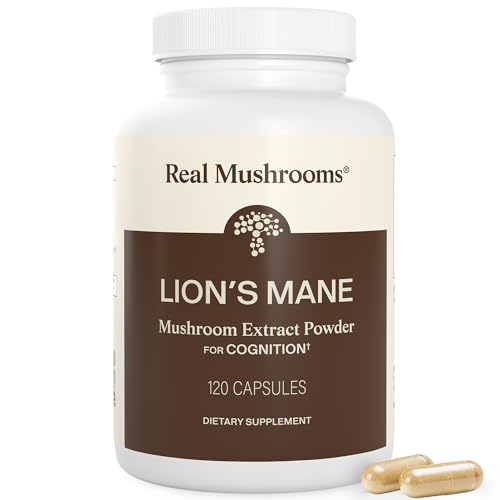
Real Mushrooms is the pick to reach for if the label matters as much as the mushroom. The brand states that its capsules are made from 100% mushroom fruiting bodies with no starch, grains or mycelium, and claims a beta-glucan content greater than 30% per capsule verified by third-party labs. That is the most specific active-compound claim any of the six listings makes.
The serving is two capsules daily rather than one, which changes the arithmetic on a 120-count bottle: this is a one-month supply at the recommended dose, not two. Real Mushrooms sits at the premium end of this set, which is the trade-off for the label detail. The brand also confirms the product is gluten-free, non-GMO and vegan, which is the closest any of these listings comes to answering the halal shell question directly. A vegan capsule shell is HPMC and not animal-derived gelatin.
The listing suggests you can break capsules open and stir the contents into food or a drink, which is useful for a younger teen who is not yet confident with capsules. The bottle at 6.75 x 4.25 x 2 in is bulkier than Double Wood's, and the two-capsule serving means you'll reorder sooner.
Pros:
- 100% fruiting body, no mycelium on grain
- Beta-glucan claim above 30% per capsule
- Vegan, gluten-free and non-GMO
- Capsules can be opened and mixed into food
- Third-party lab verification mentioned in the listing
Cons:
- The most expensive of the four capsule and softgel picks
- Two capsules a day, so 120 lasts one month
- Bulkier bottle than the winner
3. LiliCare Lion's Mane Mushroom Gummies for Kids, Teens & Adults — Best premium
The one pick built for a household that shares a bottle across ages, with a stated vegan gummy base and a blended nutrient stack around the mushroom.

Best for: a household sharing one bottle across kids, teens and adults Skip it if: you only want lion's mane and nothing else
LiliCare is the most expensive pick here and the reason to spend it is the format plus the family positioning. It's a pectin-based gummy, described in the listing as vegan and free from gelatin, gluten and artificial additives, which is the direct answer to the halal shell question that most capsules dodge. The two-pack of 60-count bottles means one shared bottle for a family without immediate reordering.
The formula is more than just lion's mane. LiliCare markets a 24-in-1 blend that includes 13 organic mushroom extracts, algal omega-3 DHA, saffron, magnesium and methylated B vitamins. For a teen, the methylated B vitamins and omega-3 are genuinely useful additions. For someone who wants only lion's mane and nothing else, that same blend is a reason to look at Double Wood instead.
The slowest seller of the six, which is worth noting: this is a newer or more specialised listing rather than a mass-market pick, and only one seller lists it. That is the honest trade-off for the format and the vegan gummy claim, and it means the buyer profile is genuinely narrower than a plain capsule.
Pros:
- Vegan pectin gummy, no gelatin
- Two-pack of 60 gummies for family sharing
- 13-mushroom blend claim with omega-3 and B vitamins
- Marketed for kids, teens and adults on one label
- Sugar-free per the listing
Cons:
- The most expensive pick here
- Blended formula so lion's mane dose is not stated
- Only one seller lists it
4. NUTRAHARMONY Lions Mane Supplement Capsules — Best for beginners
A vegan capsule at 1,200mg per serving with a stated 25% polysaccharide standardisation, at a price that makes a first bottle easy to justify.

Best for: a first-time buyer testing a higher single-capsule dose Skip it if: you want a softgel or a chewable
NUTRAHARMONY is the beginner pick because it says the right things on the label at an entry price. The dose is 1,200mg per capsule, the highest single-capsule figure in this set. The listing states a fruiting body extract standardised to 25% polysaccharides, which is meaningful specification and the second-most transparent label after Real Mushrooms. The capsule is described as vegan, which addresses the shell question.
This is the second-cheapest of the six. That combination of a stated dose, a stated standardisation, and a vegan capsule at an entry price is what makes it a low-risk first bottle. The 120-count size gives you a long window to judge whether the supplement is doing anything for concentration or study focus without committing to premium spend.
The trade-off against Real Mushrooms is beta-glucan disclosure: NUTRAHARMONY states polysaccharide content rather than beta-glucan content, and polysaccharides are the broader category that includes beta-glucans plus other compounds. The trade-off against Double Wood is brand track record on this data: NUTRAHARMONY sits well behind Double Wood on how often it moves through the category.
Pros:
- 1,200mg per capsule, highest single dose in this set
- Vegan capsule stated in the listing
- Fruiting body extract with 25% polysaccharide claim
- Second-cheapest pick here
- Full 120-count bottle
Cons:
- Polysaccharide claim is broader than a beta-glucan claim
- Sells less often than Double Wood and Real Mushrooms
- No stated halal certification
5. Horbäach Lions Mane Mushroom Supplement — Best budget pick
The cheapest of the six in a softgel format, useful for someone who finds hard capsules difficult to swallow.

Best for: a shopper trying lion's mane for the first time without spending much Skip it if: you need a vegan or vegetarian-friendly shell
Horbäach is the cheapest of the six and the only softgel in the set. That format matters: softgels are typically easier to swallow than hard-shell capsules because they're smaller and slide more readily. For a teen who has struggled with tablets, this is worth trying before you conclude they need a gummy.
The listing describes the product as laboratory tested and free from gluten, wheat, yeast, milk, lactose and artificial flavourings or sweeteners, and it calls out non-GMO status. What it does not say, and this is important for a halal-conscious buyer, is anything about the softgel shell. Softgels are traditionally made from gelatin, and gelatin is usually animal-derived. If halal compliance matters, this is the one pick I'd flag for a direct manufacturer email before purchase.
The bottle is 80 softgels rather than the 120 the capsule picks offer, so the value gap on price per serving narrows once you do the arithmetic. The listing does not publish a milligram dose in the specifications provided, which is the other reason to treat this as a starter bottle rather than a long-term commitment.
Pros:
- The cheapest of the six
- Softgel format, easier to swallow than a hard capsule
- Free from gluten, wheat, yeast, milk and lactose per the listing
- Non-GMO claim on the label
Cons:
- 80 count rather than 120
- No milligram dose published in the specifications
- Softgel shell material not confirmed as halal or vegan
- No fruiting body versus mycelium detail
6. Neviss Teen Vitamin Gummies with Mushroom — Best for heavy use
A gummy formulated for teens 10+ with a seven-mushroom blend and a multivitamin stack, aimed at students who study late and need something they'll actually take.

Best for: a teen aged 10+ who studies late and prefers a chewable Skip it if: you want a single-ingredient supplement
Neviss is the pick for a teen who won't take a capsule and needs a chewable that also delivers something beyond lion's mane alone. The listing names the product as a Teen Vitamin Gummy with Mushroom, calls out ages 10 and up, and describes a seven-mushroom blend with B12, B6, D3, vitamin C, phosphatidylserine, L-tyrosine and ginkgo biloba. That stack maps closely onto the nutrients most commonly discussed for adolescent focus and study.
The listing describes the gummies as sugar-free, gelatin-free, gluten-free, soy-free, wheat-free, yeast-free, non-GMO and third-party tested. Gelatin-free is the phrase that matters for the halal shell question, and it's stated directly. The count is 60 per bottle, which is a one-month supply at two a day for most teen gummy formulas, though the serving size is not printed in the data I have.
The trade-off is complexity. This is not a lion's mane bottle: it's a multivitamin with lion's mane inside. That means you cannot easily compare it on milligrams of lion's mane against Double Wood or NUTRAHARMONY, because the mushroom dose is not itemised. Sells more slowly than the winner, which is what a specialist teen-focus gummy would be expected to do.
Pros:
- Formulated and marketed for teens 10+
- Gelatin-free and sugar-free per the listing
- Seven-mushroom blend plus B12, B6, D3 and vitamin C
- Third-party tested claim on the label
- Chewable format for teens who refuse capsules
Cons:
- Lion's mane dose not stated separately
- 60-count bottle, smaller than the capsule picks
- Blended formula, not a single-ingredient supplement
Capsules or gummies for a teen who won't swallow pills?
This is the practical question most parents land on. Here is how I'd split it.
If your teen can swallow a capsule, the capsule wins. It carries a higher dose per serving, no added sugars or gummy fillers, and typically a cleaner ingredient list. Double Wood at 1,000mg and NUTRAHARMONY at 1,200mg are both single-a-day options. Real Mushrooms is two a day but delivers the most detailed extract label.
If your teen refuses capsules, do not force it. The refusal is the whole reason the supplement won't get taken consistently, and an untaken supplement does nothing. LiliCare and Neviss are the two gummy picks here, and both state a gelatin-free base. LiliCare is broader in scope and family-friendly; Neviss is targeted at teens 10+ specifically and leans into the study-and-sports angle.
The softgel middle ground is Horbäach. Softgels are usually smaller and easier to swallow than hard capsules, so a teen who won't take a hard-shell capsule might still manage a softgel. That's the case for keeping the budget pick on the shortlist even without a stated dose.
How long does a bottle actually last?
Count per bottle only tells you the answer once you know the serving size. Here is what the listings state:
- Double Wood: 120 capsules, one a day per the brand's two-month wording. Two months per bottle.
- Real Mushrooms: 120 capsules, two a day per the listing. One month per bottle.
- NUTRAHARMONY: 120 capsules, dose per day not stated in the specifications I have.
- Horbäach: 80 softgels, dose per day not stated.
- LiliCare: two bottles of 60 gummies each, serving size not itemised in the data.
- Neviss: 60 gummies, serving size not itemised.
Double Wood is the clearest on how long a single bottle actually stretches. That two-month arithmetic is the reason it moves through this category so quickly: buyers who reorder every eight weeks build a routine faster than buyers reordering every four. If a two-month supply matters, that is the pick to start with.
What the listings do not tell you
Three things you won't find in any of these six product listings, and that you should assume you need to ask about before buying for a teen:
- A printed halal certification. None of the six carries one in the data I have. Vegan and gelatin-free claims are close but not the same. If halal is a hard requirement, email the brand.
- Age suitability for lion's mane specifically. Neviss states 10+ on the label. LiliCare mentions kids, teens and adults. The other four are adult supplements by default. A paediatrician is the right person to ask before giving any mushroom supplement to a child.
- Interaction with medication. Lion's mane is a bioactive supplement. If your teen takes anything else, from ADHD medication to allergy antihistamines, check with a pharmacist first.
None of that is unique to these products. It applies to any lion's mane bottle you'd pick off a shelf. The listings are marketing copy, not a full medical brief.
The verdict
Double Wood Supplements Organic Lion's Mane is the pick I'd put in most baskets. A 1,000mg single-a-day capsule, a 120-count bottle that lasts two months, and a manufactured-in-the-USA claim with organic labelling is the cleanest combination of dose, duration and label detail in this set. It sells faster than any other pick here, which suggests buyers reorder rather than switch away.
Two conditions flip it. If beta-glucan content and fruiting body sourcing matter more to you than daily convenience, Real Mushrooms is the runner-up worth paying premium for: it's the only bottle stating greater than 30% beta-glucans with third-party lab verification, and it's confirmed vegan. If your teen won't swallow a capsule, LiliCare's pectin gummy two-pack is the family-friendly premium option, and Neviss is the teen-targeted alternative if you want a supplement built explicitly for a 10+ study routine.
For halal certification specifically, treat every pick in this set as unconfirmed until you have a certificate from the manufacturer. The mushroom itself is not the question. The shell, the base and the binders are.
FAQ
Is lion's mane halal for a Muslim teenager to take?
Is lion's mane halal depends on the ingredients around the mushroom, not the mushroom itself. Lion's mane is a fungus and inherently plant-based. The halal question sits with the capsule shell (gelatin versus vegan HPMC), the gummy base (gelatin versus pectin), and any solvents or binders. None of the six listings here carries a printed halal certification, so contact the manufacturer for confirmation before buying.
Is a lion's mane supplement worth it for a teenager who studies a lot?
Is a lion's mane supplement worth it depends on whether your teen will take it consistently for eight weeks and whether their doctor agrees. Lion's mane is marketed for focus, memory and cognitive support in these listings, but marketing claims are not clinical outcomes. Talk to a paediatrician before starting, particularly if your teen takes any other medication, and treat any supplement as one small part of study habits rather than a shortcut.
What is the difference between fruiting body and mycelium lion's mane?
The difference between fruiting body and mycelium is what part of the mushroom you're actually consuming. The fruiting body is the visible white pom-pom mushroom, richer in beta-glucans. Mycelium is the root network, and when grown on grain and dried, the grain comes with it and dilutes active compounds. Real Mushrooms and NUTRAHARMONY specify fruiting body in this set. The others do not.
Double Wood versus Real Mushrooms: which lion's mane wins?
Double Wood versus Real Mushrooms comes down to what you weigh more heavily. Double Wood offers a one-a-day 1,000mg capsule and a two-month supply per 120-count bottle at a mid price. Real Mushrooms is a two-a-day fruiting body extract with a stated beta-glucan minimum above 30% and a vegan capsule at a premium price. If label detail matters most, Real Mushrooms wins. If daily simplicity wins, Double Wood.
Can a teen aged 10 take these lion's mane supplements safely?
Can a teen aged 10 take these lion's mane supplements is a question for a paediatrician, not a supplement listing. Neviss is the only pick in this set explicitly marketed for ages 10 and up. LiliCare mentions kids, teens and adults on its label. The remaining four are adult supplements by default. Any mushroom supplement given to a child should be cleared with a doctor first, especially alongside other medication.
Start with the pick that matches how your teen will actually take it. If capsules are fine, Double Wood is the cleanest single-ingredient choice at a 1,000mg daily dose with a two-month bottle. If capsules are a fight, do not spend weeks losing that fight: a gummy your teen will chew every morning outperforms a capsule that sits in the cupboard. LiliCare works for a whole household. Neviss works for a teen with a specific study routine. Whichever you pick, ask the manufacturer for a halal certificate and clear the supplement with your paediatrician before it becomes part of anyone's morning.