Best Full Leg Compression Sleeve for Runners
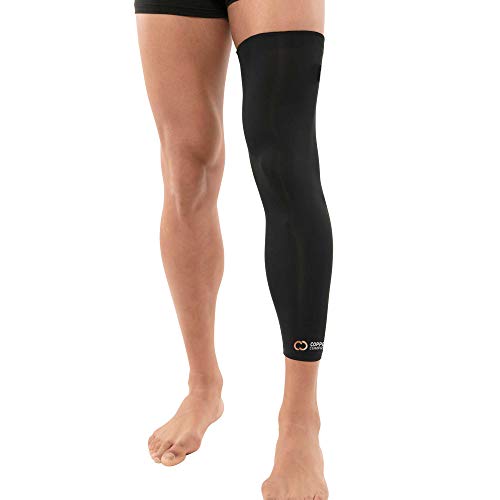
Five full-leg compression sleeves compared on fit, coverage and stated compression, with the winner named and the runner-up condition spelled out.

By Christopher CarrUpdated 16 min read
On this page
- Best full leg compression sleeve at a glance
- What actually decides a full-leg sleeve
- How I screened these five listings
- 1. Copper Compression Leg Compression Sleeve — Best overall
- 2. Ruilaibao 2 Pack Full Leg Compression Sleeves — Best budget pick
- 3. SKDK Full Leg Sleeves Long Compression Leg Sleeve Knee — Most versatile
- 4. KEKING Full Leg Compression Sleeves — Best for families
- 5. Incrediwear Leg Sleeve — Best premium
- Graduated compression vs. even pressure: which do you need?
- How to size a thigh-to-ankle sleeve without guessing
- What the listings do not tell you
- Copper Compression vs. Incrediwear: which recovers faster?
- The verdict
- FAQ
The best full leg compression sleeve is the Copper Compression Leg Compression Sleeve, a 1.45 oz thigh-to-ankle sleeve that gives even, all-day pressure without the medical bite of a graduated stocking. If you want the strongest stated pressure figure in this set, the KEKING Full Leg Compression Sleeves list a 20-30mmHg graduated range, which is the number a physio is more likely to ask about after surgery or a long-haul flight.
Best full leg compression sleeve at a glance
| Pick | Coverage | Stated compression | Price |
|---|---|---|---|
Best overall Copper Compression Leg Compression Sleeve |
Thigh to just above ankle | Even, not graduated | Check Price |
Best budget pick Ruilaibao 2 Pack Full Leg Compression Sleeves |
Full leg, silicone top grip | Graded (no mmHg listed) | Check Price |
Most versatile SKDK Full Leg Sleeves |
Full leg, patella reinforcement | Adjustable knee wrap claim | Check Price |
Best for families KEKING Full Leg Compression Sleeves |
Thigh-high, 360° fit claim | 20-30mmHg graduated | Check Price |
Best premium Incrediwear Leg Sleeve |
Quad, knee and calf | Circulation, not compression | Check Price |


What actually decides a full-leg sleeve
Most guides compare fabric and brand. That is not what decides it. Two questions do.
First: do you need graduated pressure or even pressure? Graduated means the sleeve is tightest at the ankle and eases as it climbs, which is the pattern medical stockings use for circulation after surgery or long flights. Only one pick in this set publishes a graduated figure, the KEKING at 20-30mmHg. The other four either give even pressure across the leg or, in Incrediwear's case, explicitly reject the compression model in favour of an infrared circulation claim. If a clinician told you a number in millimetres of mercury, that decides the pick before you look at anything else.
Second: is the sleeve a knee brace with legs attached, or a leg sleeve with a knee panel? Two of the five picks sit in Amazon's Knee Braces category, and one adds a patella reinforcement panel. A runner with a grumbling knee wants that structure. A traveller worried about calf swelling on a flight does not, and the extra bulk around the joint will feel like a hinge that is not there.
Once you have answered those two, size and fabric fall into place. Skip either, and you end up with a sleeve that either slides down by lunchtime or squeezes the ankle so hard you take it off in the car.
How I screened these five listings
I lined up every full-leg sleeve on Amazon with a full published spec sheet, then cut anything that only covered the calf or only the thigh. Then I cut anything without a stated size and colour, because sizing is where most refunds start. Five listings survived and each one lists at least a size, a colour and a count.
From there I ranked on three criteria in this order:
- Coverage claim honesty. Does the listing actually describe thigh-to-ankle wear, or is it a knee brace stretched to sound bigger? Copper Compression, Incrediwear and KEKING pass cleanly. SKDK and Ruilaibao are marketed with heavy knee-brace language, and I have graded them for that.
- Compression detail. A published mmHg figure beats a vague "graded compression" line. Only KEKING publishes a number.
- Practical detail on the page. Weight, dimensions, an anti-slip band, a released date. Incrediwear is the only pick with a listed dimension and a model number, LS804, and a released date of 2017, which is the closest thing here to a track record.
Three sleeves were cut for missing weight and dimension data. One was cut because the count was ambiguous between a single sleeve and a pair. What made the cut is what you see.
1. Copper Compression Leg Compression Sleeve — Best overall
Copper Compression is the right default because it is the only sleeve here that names its actual coverage from the top of the thigh to just above the ankle and keeps the weight to 1.45 oz.
Best for: all-day wear from thigh to ankle without figure-hugging pressure Skip it if: you want graduated medical-grade compression
Copper Compression positions this as a sleeve you wear from morning to night, and the 1.45 oz listed weight is what makes that plausible. It is the lightest in this set by a wide margin. The material is described as copper-infused and sweat-wicking, and Copper Compression says the fit runs from thigh top to just above the ankle, which is genuinely thigh-to-ankle rather than a knee sleeve marketed long. Four sizes are offered from Small to X-Large, and you get a single sleeve per purchase, not a pair.
The trade-off is honest. This is not a graduated medical sleeve. There is no mmHg number attached, so if a doctor gave you a target pressure range, you cannot match this to it. You get even, all-day light compression, which is what most non-clinical buyers actually want for a desk day, a long drive or a shift on your feet. Against the two knee-brace-style picks in this set, Copper Compression loses the patella reinforcement panel. Against Incrediwear, it loses the infrared circulation claim, and against KEKING, it loses the published pressure figure. In exchange, it has the coverage description a full-leg buyer came here to read.
Pros:
- Lightest listed weight in the set at 1.45 oz
- Coverage genuinely runs thigh top to above ankle
- Four sizes cover a wide range of leg lengths
- Copper-infused, sweat-wicking fabric per the listing
- Sells faster than the other four picks here
Cons:
- No mmHg figure, so not a medical replacement
- Single sleeve per purchase, not a pair
- No published dimensions to check against a long thigh
- Not graduated, so poor for calf-first swelling
2. Ruilaibao 2 Pack Full Leg Compression Sleeves — Best budget pick
Ruilaibao is the cheapest pick here and the only one whose listing describes silicone anti-slip strips at the top, which is the single feature that decides whether a thigh-high sleeve stays up.

Best for: a first sleeve to test whether full-leg coverage suits you Skip it if: you want a lightweight sleeve for running
Ruilaibao is the cheapest of the five, and it is the entry-price way to find out whether a full-leg sleeve is a shape you actually get on with before you spend more. The listing calls out two silicone anti-slip strips at the top band, which is the mechanical fix for the classic thigh-high problem of slow all-day slippage. The sleeve weighs 7.05 oz, which is heavier than Copper Compression and heavier than Incrediwear, but the extra fabric is where the durability claim comes from.
Ruilaibao sits in the Knee Braces category and much of the listing language is about ACL, PCL and meniscus support. Treat that as marketing framing rather than a clinical claim. The compression is described as graded but no mmHg number is attached, so it is not a substitute for a prescribed stocking. The trade-off against the top pick is weight. At 7.05 oz this is noticeably more sleeve on the leg than the 1.45 oz Copper Compression, and if you run in it, you will feel that. It is the slowest seller in this set, which is worth knowing when you weigh the low price against the other picks.
Pros:
- Cheapest of the five picks here
- Silicone anti-slip strips at the top band
- Listed as durable, moisture-wicking fabric
- Available in size Large with a clear colour
Cons:
- Heaviest full-leg sleeve at 7.05 oz
- Graded but no mmHg figure published
- Slowest seller of the five
- Marketed heavily as a knee brace
3. SKDK Full Leg Sleeves Long Compression Leg Sleeve Knee — Most versatile
SKDK is the sport-leaning pick because it ships as a pair at 0.6 lb combined and adds a patella reinforcement panel, which is what a basketball or football player wants around a working knee.

Best for: court and field sport where knee support matters most Skip it if: you need a single slim sleeve under work trousers
SKDK is the only pick in this set that ships as a pair, at 0.6 lb for the two sleeves together. That works out lighter per sleeve than Ruilaibao. The listing describes an adjustable wrap at the knee and a patella reinforcement panel built into the length of the sleeve, which is why the marketing runs through basketball, football, tennis, cycling and skiing. If you play a court sport, the knee panel is the reason to look at this one before the Copper Compression.
The compromise is that it reads and behaves like a full-length knee support. If you wanted a smooth thigh-to-ankle sleeve to sit unobtrusively under jeans on a long-haul flight, this is not that. Sizing runs through the listing's own chart, and SKDK explicitly asks you to measure before ordering rather than trust the standard S-M-L map. Against Copper Compression, SKDK is bulkier. Against Incrediwear, it is thicker fabric and firmer around the joint. Against KEKING, it lacks the published mmHg figure. What you gain is a paired sleeve set with a patella panel at a mid price position.
Pros:
- Pair rather than single sleeve
- Patella reinforcement panel at the knee
- 0.6 lb combined listed weight for two sleeves
- Marketed for a wide range of court and field sports
Cons:
- Bulkier around the knee than a plain sleeve
- No mmHg pressure figure listed
- Sizing needs the brand's own chart
- Only one seller lists it
4. KEKING Full Leg Compression Sleeves — Best for families
KEKING is the only pick in this set with a published mmHg figure, listed as 20-30mmHg graduated, which is the number a clinician actually names.

Best for: shoppers who want the strongest stated compression figure here Skip it if: you dislike a very tight ankle grip
KEKING is the pick to reach for when the buyer already knows the number they need. The listing states 20-30mmHg graduated pressure, tightest at the ankle and easing up the leg. That is a firm range, and KEKING warns in its own listing that the sleeve will feel tighter than an average support sock. Believe them. Graduated means the ankle is the working end, and buyers who have never worn medical stockings often mistake that ankle grip for a bad fit on the first day.
Beyond the compression figure, KEKING describes a 360° thigh-high fit, a 4-way stretch 3D knitted fabric and sweat-wicking construction. It is offered in size Large, all black, and ships as a single sleeve. That single-sleeve count is worth flagging: it costs more than Ruilaibao's pair and more than SKDK's pair, and it is the most expensive pair-adjusted pick in this set once you buy two. In exchange you get the only published mmHg number, and if that is what decides your purchase, nothing else in this set competes.
Pros:
- Only pick with a published 20-30mmHg figure
- Graduated design, tightest at the ankle
- 4-way stretch knitted fabric per the listing
- 360° fit claim from thigh to ankle
Cons:
- Tighter ankle than most buyers expect
- Single sleeve at a premium position
- No published weight or dimensions
- Sits in the calf and shin support category
5. Incrediwear Leg Sleeve — Best premium
Incrediwear is the recovery-first pick because the brand explicitly rejects the compression model, and cites its own figures of 22% increased circulation in 20 minutes and 31% faster recovery.

Best for: post-op recovery where circulation matters more than squeeze Skip it if: you want firm mechanical support after a sprint session
Incrediwear is the odd one out here on purpose. The brand says traditional full leg compression sleeves restrict blood flow, and its own sleeve is instead marketed on an element-infused fabric that emits infrared waves when warmed by body heat. Incrediwear cites 22% increased circulation in 20 minutes, 51% pain reduction and 31% faster recovery, and says the figures are backed by peer-reviewed research. Treat those as the brand's claims rather than measured facts on your leg, but note that Incrediwear is the only pick here with a published model number, LS804, dimensions of 4.6 x 2.3 x 2.3 in, a released date of 2017 and a listed weight of 13.6 g.
The reason to buy this is post-op or lymphedema recovery where a physio wants circulation rather than pressure, or ACL and MCL rehabilitation where the leg does not tolerate mechanical squeeze. The reason to skip it is that if you came here for compression, this sleeve is not what you are looking for. It is also the most expensive pick in this set, and the slowest seller after Ruilaibao. What you pay for is coverage of quad, knee and calf in one low-profile sleeve you can wear under athletic gear.
Pros:
- Only pick with a published model and released date
- Full quad, knee and calf coverage
- Low-profile fabric wears under athletic gear
- Explicitly designed for post-op and lymphedema use
Cons:
- Highest price position in the set
- Not a compression sleeve in the usual sense
- Circulation figures are the brand's own
- Second-slowest seller of the five
Graduated compression vs. even pressure: which do you need?
The word "compression" hides two very different products. A graduated sleeve is tightest at the ankle and eases as it climbs, and it is the design a doctor prescribes for varicose veins, oedema, DVT prevention on flights and post-surgical recovery. A number in millimetres of mercury, written as mmHg, tells you how tight. Medical grade sits at 20-30mmHg and above.
- You want graduated pressure if a clinician has named an mmHg range, if you swell around the ankle first, or if you sit for very long stretches. KEKING is the only pick here that publishes 20-30mmHg.
- You want even pressure if you want warmth, mild support and something you can wear all day without your ankle bruising against the elastic. Copper Compression is the shape that suits this best.
- You want structural knee support with sleeve legs if a bad knee is the actual reason you are buying. SKDK adds a patella reinforcement panel, Ruilaibao sits in the same category.
- You want circulation without squeeze if you are in post-op recovery and pressure hurts. Incrediwear is the pick that rejects compression outright.
If two of those describe you, pick the one that is closest to a clinical instruction. Sitting for eight hours a day beats the "I run at weekends" case every time.
How to size a thigh-to-ankle sleeve without guessing
Most refunds on full-leg sleeves are sizing problems, and most sizing problems come from measuring the calf and hoping the thigh will follow. It will not. Full-leg sleeves need three measurements taken with the leg relaxed and the feet flat on the floor.
- Ankle circumference, at its narrowest point just above the bone.
- Calf circumference, at its widest point.
- Mid-thigh circumference, roughly a hand's width above the top of the kneecap.
Compare all three to the brand's own chart, not the generic S-M-L on the product page. Copper Compression says to stand with feet parallel and legs relaxed to size. SKDK asks you to check the size chart carefully before ordering. KEKING publishes a graduated fit that will feel tighter than a normal sock at the ankle, so measure the ankle first and let it lead the size choice.
Two practical warnings. A thigh-high sleeve on a slim thigh will slide down by afternoon unless the top band has silicone grip. Ruilaibao is the only pick here that lists silicone strips. And a sleeve sized to the thigh but not the ankle will bunch behind the knee within a hundred steps. If your ankle is a whole size smaller than the thigh chart, buy the smaller size and stretch it upward rather than the larger size and let it slip.
What the listings do not tell you
Product pages sell you the compression story and hide the washing story. Three things worth knowing before the sleeve arrives:
- Washing degrades elastic. No pick in this set publishes a wash cycle count. Air-dry every sleeve, and expect 4-way stretch fabric to loosen after several dozen washes even if the seams hold.
- Silicone grip strips wear out. Ruilaibao's anti-slip band is the mechanism that keeps the sleeve up, and skin oils are what kill it. A rinse after wear extends the grip.
- A single-sleeve purchase means one leg. Copper Compression, Ruilaibao, KEKING and Incrediwear all ship as one sleeve. SKDK is the only pair in the set. If you need both legs covered you are buying twice, and the price rank shifts once you account for that.
Colour choice is functionally black across the set. Nothing here comes in nude or beige, so a full-leg sleeve worn under office trousers will hint through in summer fabrics.
Copper Compression vs. Incrediwear: which recovers faster?
The two picks people most often cross-shop are Copper Compression and Incrediwear, and they answer different questions.
Copper Compression gives you an even, light squeeze from thigh to ankle at 1.45 oz. It is designed to sit on the leg all day and to help the muscles feel supported rather than to move fluid out of them. Incrediwear rejects that model. The brand's argument is that pressure restricts blood flow, and its infrared fabric is meant to raise circulation instead, with its own figures of 22% increased circulation in 20 minutes and 31% faster recovery. Both are marketing claims, both are attributed, and both point at very different use cases.
If you have just finished a hard training block and want a sleeve that keeps the leg warm and quiet through the working day, Copper Compression is the pick. If you are working through post-op recovery or a physio's rehab programme where the leg does not want pressure on it, Incrediwear is the pick. Neither replaces the other.
The verdict
The best full leg compression sleeve for most buyers is the Copper Compression Leg Compression Sleeve, because it delivers the one thing a shopper searching for a full-leg sleeve actually wants: honest thigh-to-ankle coverage in a 1.45 oz sleeve that you can wear from breakfast to bedtime without noticing it. Four sizes, copper-infused fabric and a clear coverage description put it ahead of the rest of the set.
Two conditions flip the recommendation. First, if a clinician has given you a compression figure in mmHg, buy the KEKING Full Leg Compression Sleeves. It is the only pick here that publishes a 20-30mmHg graduated range, and matching a doctor's number beats any other consideration. Second, if you are working through post-op recovery, ACL rehab or lymphedema where mechanical pressure hurts, buy the Incrediwear Leg Sleeve. It is the only pick that explicitly rejects the compression model and coverage runs from quad through knee to calf. For a bad knee under sport, SKDK's patella panel is the reason to sidestep the top pick, and for a first sleeve on a tight budget, Ruilaibao is the way to test the shape.
FAQ
Does a full leg compression sleeve actually help with swelling?
A full leg compression sleeve helps with swelling only when the design matches the swelling pattern. Graduated pressure, tightest at the ankle, is the shape used to move fluid up the leg. KEKING is the only pick here that publishes a 20-30mmHg graduated figure. Even-pressure sleeves like the Copper Compression give warmth and light support, but they are not a substitute for a prescribed medical stocking.
Is the best full leg compression sleeve worth buying if I only run at weekends?
Worth buying, yes, but not the most expensive one. A weekend runner does not need the graduated mmHg range that KEKING publishes and does not need the Incrediwear recovery framing either. The Copper Compression sleeve at 1.45 oz is light enough to wear during a run and afterwards, and its even pressure suits general muscle support rather than clinical recovery. Ruilaibao is the cheaper way to try the shape.
What is the difference between a knee brace and a full leg sleeve?
The difference between a knee brace and a full leg sleeve is coverage and structure. A knee brace concentrates support at the joint, often with a patella panel or stays. A full leg sleeve runs thigh to ankle and prioritises even coverage. SKDK sits between the two categories, with a patella reinforcement built into a full-length sleeve. Copper Compression is a truer sleeve, Ruilaibao is a brace-styled sleeve.
How does Copper Compression compare to KEKING head to head?
Copper Compression against KEKING is even pressure versus graduated pressure. Copper Compression at 1.45 oz is lighter and describes thigh-to-ankle coverage without publishing an mmHg figure. KEKING publishes 20-30mmHg graduated pressure and warns that it feels tighter than a normal sock. Copper Compression is the daily-wear pick, KEKING is the clinical-number pick. Neither replaces the other, and the choice comes down to whether a doctor named a number.
What should I avoid when buying a full leg compression sleeve?
Avoid sleeves that publish only a size and a colour and nothing else, avoid buying by leg length alone without an ankle measurement, and avoid trusting knee-brace marketing on a listing that is really a full-length sleeve. Also avoid assuming a single-sleeve purchase covers both legs. Copper Compression, KEKING, Incrediwear and Ruilaibao all ship as one sleeve unless you buy in pairs.
Start with the ankle measurement. That one figure decides more about how a full-leg sleeve wears than any other number on the size chart, and it is the one buyers most often skip. Match it to the coverage you actually need, thigh-to-ankle for daily wear, graduated for a clinical target, patella-reinforced for a working knee, and buy the pick that answers that question first. Copper Compression is the right default because it does the ordinary job well: light, honest coverage, four sizes, and a fabric spec written for all-day wear rather than a highlight reel. Get the size right and it is the sleeve you forget you are wearing, which is the only test that matters.